VERSES: Exodus 18:1-27
MEMORY VERSE: Exodus 18:24 "And Moses hearkened to the voice of his father-in-law, and did all that he said."
BOOK TO REMEMBER: Review all 39 books of the Old testament until everyone knows them. Reviewing is a good way of remembering.
PRAYER: Thank God for our families and the help that they give us.
SPECIAL SONG: Jesus Loves Me (see February - Songs We Sing In Bible Class #2 on this blog).
VISUAL AID: Bible map and TV Box (see February - Visual Aid #1 on this blog for instructions).
LESSON POINTS:
- Remember when Moses ran away to Midian after he had killed the Egyptian who was hurting one of God's people? He had run south towards this area right here on the map. (Point to area). He had found a job taking care of sheep for a man who was a priest named Jethro. Moses had married one of Jethro's daughters named Zipporah and they had two sons named Gershom and Eliezer. Moses had sent his wife and two children back to Jethro for a time and Jethro had heard about all the good things that God had done for Moses and for Israel and how the LORD had delivered Israel from the hands of Pharaoh.
- Jethro had sent word to Moses telling him that he, Zipporah, Gershom and Eliezer were going to come for a visit and had camped at the mountain of God. When Moses heard that, he went out to meet his father-in-law, he was happy to see him and took him back to his tent and told him all that God had done to Pharaoh and the Egyptians and everything that had happened to them. Jethro was happy for everything good that had come to the Israelites and said that now he knew that the LORD God was greater than all the little gods. So Jethro offered a burnt offering to God. Afterwards, Aaron and all the elders or leaders of the people went to eat a meal with Moses and Jethro.
- The next day, the children of Israel came to Moses with questions and problems and, like he had been doing, Moses helped the people all day from morning to evening.Iin fact, there was always a long line of people needing Moses' help with their problems. Jethro watched and saw what Moses was doing all day and asked him why Moses sat all by himself while the people waited to talk to him. Moses said that the people come to me to ask an answer from God when they have a problem and I make them know the commandments of the LORD.
- Jethro suggested that the way Moses was judging the people was not a good way. He said that Moses would wear himself out, that it was too much for him, and he couldn't do it alone. He told Moses to listen to him and God would be with him. Jethro went on to say that Moses should tell God their problems, but that he should teach the people the laws and commands of God and how they should walk and the work they should do. He said that Moses should search and find capable, trustworthy persons who respect God, men of truth and honesty. Jethro's idea was to set these men over different numbers of people in groups of 1000s, 100s, 50s and 10s. By teaching these men God's laws and setting them over groups of people, then only the bigger problems would be decided by Moses after he consulted God. This would be much easier on Moses.
- Moses listened to all that his father-in-law, Jethro, had said and then Moses did what Jethro had said. Jethro's visit came to a close and he went back to his own home.
"Older Student" Tips:
- Take a look at the distance from Rephidim and Mt. Horeb. Both places are fairly close to each other. Mt. Horeb is where is where the water came from the rock that Moses struck. Rephidim is where the Amalekites from last time fought the Israelites.
- Why was Jethro's idea a good idea? It was easier on Moses' health and he would be judging the people from morning til evening every single day.
ACTIVITY: 1000's - 100's - 50's - 10's
Materials needed: On 9" x 12" piece of construction paper, five other smaller different colors of construction paper, stencils of different sized nestled circles, a pencil, scissors, and crayons.
- Pass out the piece of 9" x 12" paper. This is the background.
- Turning the background portrait-style, leave a margin of 3 or 4 inches at the top of the paper before gluing the circles down. This will be where the title is written.
- The students will trace five different sized circles that fit into each other. I went through my kitchen, found bowls and lids and traced each circle with a pencil on a different color of paper.
- Cut out the circles.
- Glue the circles onto the background, beginning with the largest circle.
- Write "1000" around the largest circle. (I used orange.)
- Write "100" around the next smallest circle. (I used blue.)
- Write "50" around the next smallest circle. (I used green.)
- Write "10" around the next smallest circle. (I used green.)
- Write "Moses" on the smallest circle. (I used purple.)
- Write "Jethro's Great Idea How Moses should Judge The People" and "Exodus 18:1-27" at the top of the paper.
- The circles represent the number of people that were judged by a capable man. Moses was in the center because he judged the more difficult problems of the people.
VERSES: Exodus 17:8-16
MEMORY VERSE: Exodus 17:11 "...when Moses held up his hand, that Israel prevailed: and when he let down his hand, Amalek prevailed."
BOOK TO REMEMBER: Review the books of the Old Testament, helping the ones who need a little help.
PRAYER: If we are His children and are obeying Him, God is our protector. He can protect us with His sword, which is the Word of God (Eph. 6:17). May we forever stay close to God's Word by reading the Bible.
SPECIAL SONG: Read, Read Every Day (see February - Songs We Sing In Bible Class #1 on this blog).
VISUAL AID: Whiteboard or Chalkboard Drawing of Activity below.
LESSON POINTS:
- While the children of Israel were camped in Rephidim, there was a nation of people called the Amalekites and they fought with God's people. Moses told Joshua to choose men from the Israelites and they would go out and fight them back. God's people did not start the fight, but we will see what happens.
- Moses told Joshua that he would stand on top of the hill with the rod of God in his hand on the next day. This was the same rod that turned into a snake before Pharaoh, parted the Red Sea, and brought water from the rock. Joshua did as Moses told him and the next day they fought against the Amalekites. Moses, Aaron and a man named Hur walked on top up a hill where they could see the fight. Moses stood on top of the hill and raised his hands. Every time Moses raised his hands, Israel would start winning the battle, but every time his hands went down, the Amalekites would start winning the battle.
- Moses tried raising his hands all the time, but his hands grew heavy and tired, so Aaron and Hur took a stone and put it under Moses, so he could sit down. Aaron and Hur stayed on each side of Moses, helping him raise his hands up. Moses' hands were then steady and did not go down until the sun went down. At the end of day, Joshua and his army defeated the Amalekites.
- God told Moses to write what happened down as a memorial, so the Israelites would not forget. Moses was to read it to Joshua, so he would not forget it either. God said that He would totally blot out the Amalekites and no would remember them anymore. Moses built an altar there at Rephidim.
"Older Student" Tips:
- Interesting way to win a battle, isn't it? There are many battles and wars that are recorded in the Old Testament. Most of the time the Israelites would win, but when they were disobedient, they would lose. If the people obeyed God and did what he said, they would always win the victory.
- This battle must have been important to God because He had Moses write the outcome down and recite it to Joshua. We have a way of constructing a memorial when we want to remember something today, don't we? That is what they were doing back then, too.
- God is true to His word. He said that the Amalekites would not be remembered and it was true. If we did not read this account in the Bible, we would have never heard of the Amalekites. No one remembers them anymore.
ACTIVITY: Holding Up Moses' Hands
Materials needed: white 9" x 12" construction with or without the above black outlines, 9" x 12" any color construction paper, scissors, crayons, glue.
- Pass out any color of 9" x 12" paper for background.
- The Bible teacher has a choice: A) Have the students draw a front view of Moses with his hands held high and two men (Aaron and Hur) from the side view, a large flat rock, and a shallow hill OR B) Copy the above blackline drawing, paste it in a Word document, change the paper orientation to 'landscape,' enlarge to the size of the document, and print.
- Draw faces and color figures, rock and hill.
- Cut figures, hill, and rock out.
- Glue hill to bottom of background paper.
- Glue rock on top of the hill, leaving a little edge at the top of the rock to tuck Moses in.
- Fold on Moses' dotted lines.
- Tuck Moses a little behind the rock, so it looks like he is sitting on the rock.
- Glue Moses' back to background and his feet to the hill.
- Glue Aaron and Hur in their proper places beside Moses, holding up his arms.
- Write "Moses' Heavy Hands" and "Exodus 17:8-16" at the top of the background.
- Write "Moses", "Aaron," and "Hur" on the appropriate people's robes.
VERSES: Exodus 17:1-7
MEMORY VERSE: Exodus 17:6 "...thou shalt smite the rock, and there shall come water out of it, that the people might drink..."
BOOK TO REMEMBER: Review the books of the entire Old Testament. Sing "The Books Of The Old Testament" (see March - Songs We Sing In Bible Class #3 on this blog).
PRAYER: Pray for rain, so that water will be plentiful for the farmers, for the animals and for us. Remember to thank God for the rain, too. Let us all be patient and kind to our family and friends and ask God to help us do that.
SPECIAL SONG: Be Patient and Kind (see April - Lesson - Joseph Meets His Brothers Who Hated Him on this blog).
VISUAL AID: Large Bible map (Perhaps made on an overhead projector - see March -Visual Aid #4), Example of Activity (see below)
LESSON POINTS:
- The huge multitude of God's people walked and walked in the wilderness. How did they know where to go? That's right! The cloud was leading them to where God wanted them to go. They stopped in a place called Rephidim, but there was no water there for the people to drink. It took a LOT of water for all those people! Remember there were over 600,000 men and that did not count the women and children.
- Because they were thirsty, the people chided or expressed their disapproval at Moses. They said to Moses, "We want water to drink. Give it to us!" That was not very nice, was it? What should the people have done? That's right! They could have been patient and quiet. God was not going to let them be thirsty forever. He was going to provide water, but He was proving the people to see if they trusted Him in providing the things that they needed. So far, they had not been very patient before when the water was bitter at Marah, were they? No. They complained. They had not been very patient before when they were hungry, were they? No. They complained. And now they are complaining again. It sounds like the children of Israel were not a very patient people.
- The people complained about Moses and asked him, "Is this why you brought us out of Egypt? To kill us?" Moses was upset with the people. He asked God, "What shall I do with this people? They are almost ready to stone me!" Stoning someone meant to throw stones or rocks at someone until they died. God told Moses to go before the people, taking the elders or the leaders with him, to take his rod that he had used to strike the Red Sea in his hand, and to stand by the rock in a place called Horeb. God stood with Moses as he hit the rock and water came out of the rock. Not a little water for all those people, but a whole lot of water and not just the people needed water, but also all of their cattle and flocks! Only God could do that!
"Older Student" Tips:
- Find Rephidim and Horeb on a map. Talk about distances. If you have chosen to make an enlarged map of this area of the world in Bible times using an overhead projector, trace the steps that the Israelites traveled with a yellow marker.
- Stress the fact here that Moses struck the rock. Later, we will see that not listening to God and following his Word can have grave consequences.
ACTIVITY: Water From The Rock Scene
Materials needed: small paper plate (6"), 5" square of dark blue construction paper, one small rock, 2" square piece of tan or white paper, tape, glue, crayons.
Note: This scene, of course, is AFTER Moses had struck the rock because there is water flowing from it.

- Pass out a small paper plate to each student.
- Around the edge of the plate, write "Moses Strikes The Rock" and "Exodus 17:1-7."
- Take blue paper and crumble it into a ball. Wrinkles are welcome.
- Unwrinkle the blue paper by pressing it with the hand.
- Tear edge of blue paper and fold it so it looks like water is coming out of a rock. (I tore my paper diagonally.)
- Glue the partially wrinkled blue paper to bottom of plate to secure in place.
- On tan or white paper, draw a 2" Moses, holding his rod in the air. (see picture below)
- Fold the bottom of Moses' robe up 1/4" or so. (see picture above)
- Place tape on the edge of Moses' robe and tape Moses to rock.
- Place rock in paper plate. You might choose to secure rock to plate using tape or glue. If you choose to use glue, it will need to dry. (I only placed the rock in the paper plate; no glue or tape. The students are careful. If the rock rolls out, it can be placed once again into the plate.)
VERSES: Exodus 16:1-36
MEMORY VERSE: "...It is manna: for they wist not what it was..."
BOOK TO REMEMBER: Malachi. Write "Malachi" on small slips of paper and hand out at the end of class.
PRAYER: Thank God for our food and for giving us the things that we need.
SPECIAL SONG: Be Patient And Kind (see April - Lesson - Joseph Meets his Brothers Who Hated Him on this blog.)
VISUAL AID: Pictures of quail, white board or chalkboard drawing of Activity below.
LESSON POINTS:
- As the children of Israel traveled by foot from one place to another, everyone started complaining about Moses and Aaron. The people said to one another, "We wish that we would have stayed in Egypt and sat near the pots cooking meat and eaten our fill of bread. But now they have brought us into this wilderness to kill all of these people because there is no food." Guess who heard them say that? God did! God told Moses that He would rain bread from heaven for all the people to eat. He explained that the people would go out in the morning and gather a certain amount of bread every day. He said He was going to test them to see if they would do just what He said. God said things would be different on the sixth day. On the sixth day, they should gather twice as much bread. God said that He was the one who was giving them something to eat. He was the provider. They wouldn't have to work for the bread, just go out and pick it up.
- Moses and Aaron said to the people that in the evening they would know that the LORD had brought them out of Egypt and in the morning they would see the glory of the LORD because God had heard their complaining. Moses said to them that when the people complained, they were complaining about God and God was hearing their complaints. Moses told the people that in the evening God would give them meat and, in the morning, He would give them bread.
- Moses spoke to Aaron and Aaron spoke to the people. Moses said to tell the people to come close because the LORD has heard their complaining. And, as they were listening to Aaron, they looked toward the wilderness and the glory of the LORD appeared in the cloud. Do we remember why was the cloud there? That's right! The cloud showed them where to go. They just followed the cloud! And as time passed, in the evening, the quails came and covered the camp. There were many, many birds! But when they got up in the morning, there was a dew all over the ground outside. When the dew was gone, there remained small white round things all over the ground. Everyone was asking each other, "What is it? What is it?" They called it manna. Moses said it was the bread from heaven that God had promised. It was white like coriander seed and it tasted like honey. Yummy! We like honey, don't we?
- God has always told people exactly what to do to please Him. This time, He told the people to gather just enough bread for each person to eat for that one day, except on the sixth day, they should pick up twice as much to last for two days. So, for example, Sunday they would pick up bread, Monday they would pick up bread, Tuesday they would pick up bread, Wednesday they would pick up bread, Thursday they would pick up bread, BUT on Friday, they would pick up bread for Friday and Saturday.They were to measure what they gathered and they were to make sure they had just the amount that Moses told them to pick up. They were to eat the bread all that day and not to have any leftovers for the next day.
- Some of the people listened, but some did not. Everything went well for those who listened to God and did what he said, but for the ones who did NOT listen and kept some of the bread for the next day, it had worms in it. Moses was very angry at the ones who did not listen to Him.
- What happened to the manna when it was left outside and no one picked it all up? Let's turn our Bibles to Exodus 16:21 and see what happened. (Read verse.) Let's put our bookmarks right here. What happened to the extra manna? That's right! When the sun got hot, it melted! At the end of the week, on the sixth day, the people were to pick up how much manna? That's right! Enough for TWO days! The people listened to Moses and guess what? The leftover manna didn't stink and didn't have any worms!
- Moses said that the seventh day was the sabbath day and they were to rest.
- But...there were some people who didn't listen and when they went out on the seventh day, was there any manna? NO! This made God angry and He asked Moses, "How long will they refuse Me?" So the people rested on the seventh day. God told Moses to set aside an amount of manna to be kept in a special place. The children of Israel ate manna for forty years in the wilderness until they came to the land that flowed with milk and honey...the land of Canaan.
"Older Student" Tips:
- Discuss why God might have chosen a quail as their meat instead of deer or bear.
- Do we see a pattern of how the children of Israel test God by their disobedience, only to repent or turn around and obey Him? Yes! Even now!
ACTIVITY: "How God Fed The People" Book
Materials needed: 9" x 12" piece of light colored construction paper, crayons.
- Hand out a piece of paper to each student.
- Fold paper in half, width-wise.
- On outside of folded paper, write "How God Fed The People" and "Exodus 16".
- Open 'book.'
- On top of the fold line, draw a line down the middle of the paper.
- On left side, write "In the evening..." at the top of the paper.
- Write "Quail" at the bottom of the left side.
- Draw a quail or a bird with a top knot in the middle of the left side of the paper. (See picture above.)
- On the right side of the paper, write "In the morning..." at the top of the paper.
- Write "Manna" at the bottom of the right side of the paper.
- Dear a basket with white circles colored in the middle. (see picture above.)
- Remember, artistic qualities are not graded in Bible class. Keep drawing simple.
VERSES: Exodus 15:1-27
MEMORY VERSE: "...and they went three days in the wilderness, and found no water."
BOOK TO REMEMBER: Zechariah. Write "Zechariah" on small slips of paper and pass out at the end of class.
REVIEW THE PLAGUES OF EGYPT: Just to keep them fresh in little minds, review the plagues in order. It is good for the teacher as well!
PRAYER: God is the Great Provider! He knows our needs before we even tell Him and He gives us what we need. Thank God for good water!
SPECIAL SONG: Be Patient And Kind (see April - Joseph Meets His Brothers Who Hated Him).
VISUAL AID: Little cups of water. A Bible map, showing Egypt, the Wilderness, of Shur, Marah, and Elim.
LESSON POINTS:
- How exciting our lesson was last time! After so many years, the children of Israel were delivered from slavery and in a miraculous way! Each and every one of the people, young and old, was able to walk through the Red Sea on dry ground and see those waves rolled back on each side! To be able to see and experience those wonders would make a person be in awe of God. God is good. God is Great! He can do all things!
- When the children of Israel crossed over to the other side of the Red Sea, they celebrated their freedom. Do you know what they did? They sang! We sing when we are happy, don't we? That is exactly what Moses and Aaron and their sister, Miriam, and all the people did! They sang a song of praise to God, thanking Him for being their strength and their salvation. God saved the people and they were happy and thankful.
- Soon, after walking for three days in the wilderness of Shur--that's the wilderness' name--they didn't find any water. No water and they were thirsty! They came to a place called Marah. 'Marah' means bitter. All of the water of Marah was bitter and they could not drink it even though they were very thirsty. When we taste our water like the water in these little cups, it tastes good and sweet. That is the kind of water that the Israelites wanted. Good, sweet water. So, guess what the people did? They complained! They talked about Moses and how he had brought them to a wilderness without any water. They asked Moses what they should they drink, and they weren't very polite when they asked because they were complaining.
- Moses prayed to God and the LORD showed him a tree. Moses threw the tree in to the bitter water and what happened? All of the water became sweet and good to drink. Right there and then, a law was made. Moses told the people that if they will diligently listen to the voice of the LORD and do what is right in His sight and keep his commandments, then God would not put any of the diseases that He had put upon the Egyptians upon the children of Israel. God would heal them. God had been good to them and He does not like complaining.
- So this huge group of people traveled on. This group of over 600,000 people walked on towards the Promised Land, the land that flowed with milk and honey. That was their destination, the place where they were going to live, the land that God had promised them.
- Their next stop was in a place called Elim and there were twelve wells of water and 70 palm trees there and they camped there by the waters.
- Can you make a bitter expression? Let's try. That's what the faces of the people looked like when they tried drinking the bitter waters of Marah. Now, let's taste our water to see if it tastes good. (Try a swallow.) Is it good? Mmmm! That is how the water tasted after Moses threw the tree in it. God provided everything the people needed, even water. What a good God we serve!
"Older Student" Tips:
- The word "awe" is an emotion, something we feel. It means to have a deep respect for something or someone, to reverence, dread, and wonder. This word is used by many people today to describe their shoes or their potato chips, but the word "awe" or "awesome" is a word that is rarely used in the Bible except to describe feelings someone feels after they see a wonder in the Bible or to describe God.
- "Diligent" is another good word that Bible students should know. Diligent means to be very, very careful in carrying out one's jobs or duties. The Bible student should study diligently, meaning when people study, they should study very carefully.
ACTIVITY: The Bitter Water of Marah
Materials needed: 9" x 12" piece of any color of construction paper, crayons.
- Hand out a piece of the 9" x 12" paper to each student. This is the background.
- Draw faces that have bitter expressions on the background.
- Write "The Bitter Water of Marah" and "Exodus 15:1-27" at the top of the background.
- Turn the paper over.
- Draw happy faces. Perhaps the students can "see through" their paper and trace their original people with happy faces this time.
- .Write "After Moses Threw The Tree In Te Water" at the top of the paper.
VERSES: Exodus 14:1-15:1
MEMORY VERSE: Exodus 14:29 "But the children of Israel walked upon dry land in the midst of the sea..."
BOOK TO REMEMBER: Haggai. Write "Haggai" on small slips of paper and hand out to students at the end of class. Just a couple more books and we are through the Old Testament! How are the students doing?
PRAYER: God is an great God! There is none like Him! He has power over all things, even the seas. May we always love Him and His Word!
SPECIAL SONG: The Wise Man Built His House Upon A Rock (see March - Songs We Sing In Bible Class #3) and Be Patient And Kind (see April - Lesson - Joseph Meets His Brothers Who Hated Him.)
VISUAL AID: TV Box (see February - Visual Aid #1)
LESSON POINTS:
- Do we remember how God was leading His people out of Egypt? That's right! By a cloud in the daytime and by a pillar of fire at night to give them light. Was this a small group of people? NO! There were 600,000 men and that did not include the women and children. That's a lot of people! How did they travel? They walked and walked and walked even the little children walked. It was a very long way.
- Finally, God talked to Moses and told him to camp between a city called Migdol and the Red Sea. God told Moses that Pharaoh was going to harden his heart again and wonder why in the world he let the people go and he would follow the people to make them return. God said that the Egyptians would truly know the He was the LORD God by what He was going to do. The people obeyed God and camped by the sea.
- It was true. Pharaoh changed his mind again and got his 600 best chariots ready and all the chariots of Egypt ready and put captains over them. Pharaoh was doing the best he could to get the children of Israel back, but the Bible says that the children of Israel went out with a "high hand", meaning God's people had the advantage since God was on their side.
- So Pharaoh's army chased God's people with all of their horses and chariots and almost caught up with them. When Pharaoh and his great company got closer, the children of Israel looked up and saw that the Egyptians were marching after them and driving their chariots after them! The people were very afraid and cried out to God. They complained and cried to Moses and said they had been OK being slaves in Egypt, at least they would not have died in the wilderness if they were still slaves. Can you imagine that? God had delivered the people from slavery through Moses and now they are complaining and wished they were back in Egypt making brick without straw again and having a very hard life!
- But Moses said to stand still and see the salvation of the Lord. He said that the LORD would fight for them and that they should be quiet. The LORD never likes complaining. (Phil. 2:14). God asked Moses why were the people crying to Him? He told Moses to lead the people forward, to lift up his rod and stretch out his hand over the sea and divide it. The children of Israel would walk across the middle of the sea on dry ground and He said that Pharaoh would follow them.
- So the angel of God that had been before the people in a cloud went behind them and stayed between the people and the army, giving light to God's people, but darkness to Pharaoh's army. Amazing! God's people could see through the night, but Pharaoh's army was in total darkness and stayed away from God's people all night! God protected His people, didn't He?
- Moses then stretched out his hand over the sea and the LORD caused the sea to go back by a strong east wind all night! The children of Israel walked right through the sea on dry ground just like God had said! On one side of them was a HUGE wall of water and on the other side of them there was a HUGE wall of water. The Egyptians continued coming after the people, chasing them right through the sea! All of them--Pharaoh's chariots and horses and horsemen!
- In the morning, when the LORD looked through the pillar of fire and the cloud and saw that all of Pharaoh's army were right behind the people, He troubled the Egyptians. They were driving their chariots so fast and so hard that their wheels came off in the middle of the sea! When the army realized that God was fighting for His people, they said, "Let's get out of here! The LORD God is fighting against us!" and turned to go back to the other side of the sea. But...it was too late! God told Moses to stretch out his hand again over the sea and what do you think happened? Let's turn our Bibles to Exodus 14:27, 28 and read for ourselves what happened. (Read verses.) Let's put our bookmarks right here. What happened? That's right! The waters came crashing back on the army and covered the chariots and horsemen and all of the army of Pharaoh. Not one of them lived.
- But, God's people--every one of them--had walked through the Red Sea on dry land and the waters had been just like walls to them on both sides! Everywhere they looked there were dead Egyptians on the sea shore. The LORD had saved Israel that day from Pharaoh and his army. They would not need to fear Pharaoh anymore! Egypt had learned that the LORD God was truly greater than all of their little gods that were made out of stone and wood. God was the greatest God! So, when the children of Israel saw the wonders that God did to the Egyptians, what do you think the people did? That's right! They feared the LORD and believed the LORD and His servant Moses. Next time we will talk about what happened on the other side of the Red Sea.
"Older Student" Tips:
- Was it unusual that the ground was dry when Moses divided the sea? YES! It should have been very muddy, but God worked a miracle and, not only parted the Red sea, but had the people walk on DRY ground! We couldn't do that, but God can...and did!
- Was the Red Sea really a red color? No. That was just the name of the sea.
- Discuss Philippians 2:14. Do we complain like the Israelites did?
ACTIVITY: Through the Red Sea
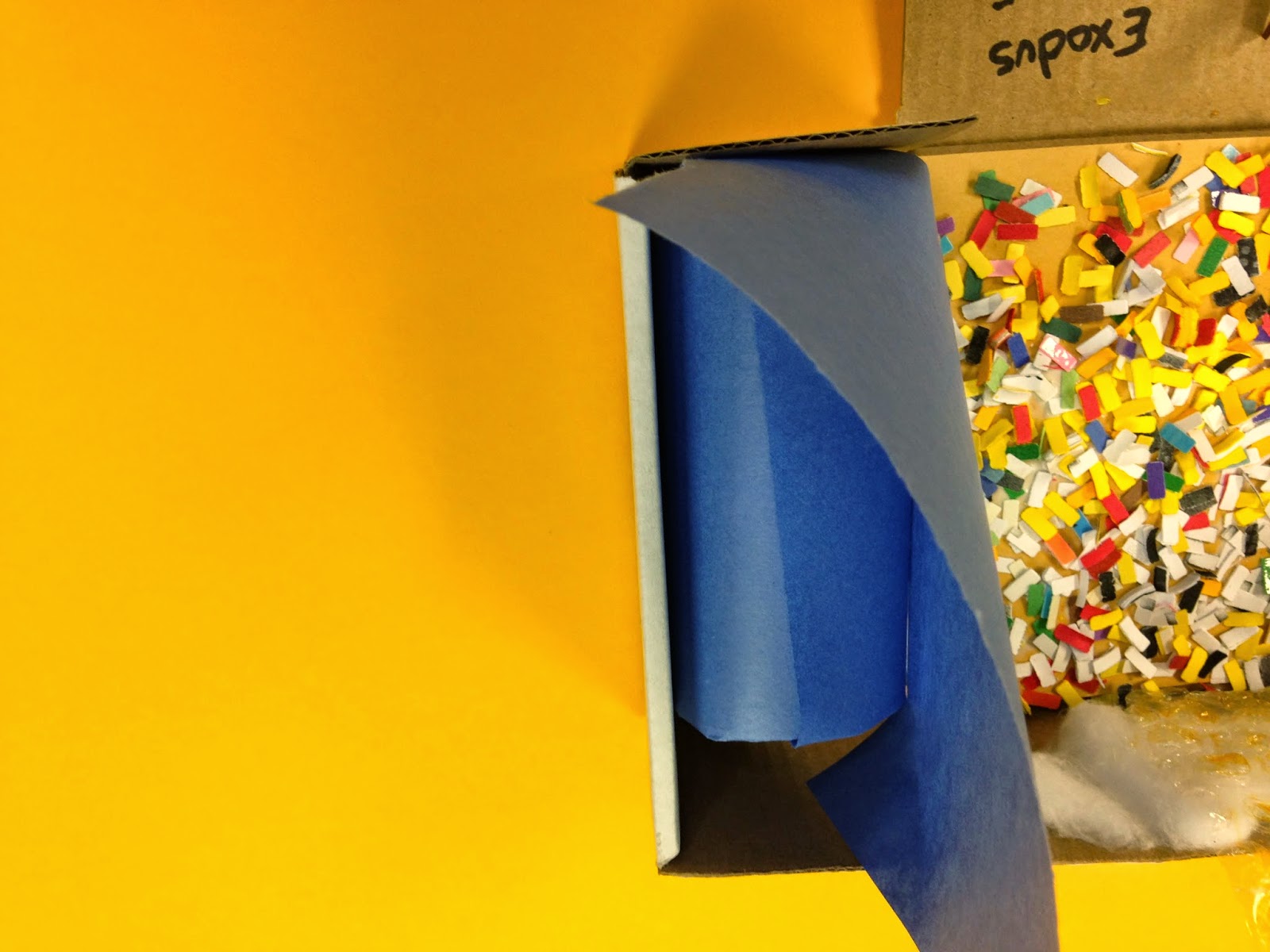
Materials needed for each child: A box (does not need to be too big), confetti or many, many paper-punched holes (I used the punched out snippits of a book binding machine), a piece of tan or brown paper, two toilet paper rolls, 10" of blue butcher paper, three cotton balls, cellophane (I used bubble wrap), 1/2" square piece of white or tan paper, glue, scissors, crayon or marker.
- Hand out a small box to each child. This is the foundation of the "Red Sea" scene.
- Cut off lid of box.
- Glue tan or brown paper to fit the bottom of the box. This is the dry land.
- Cover two toilet paper rolls with blue butcher paper, stuffing the ends inside the rolls. These are the rolled back waves of the Red Sea.
- Tape extra 3" x 3" blue paper to toilet paper roll, so it looks like the waves of the sea.
- Tape each paper roll to each side of the box, using a rolled piece of tape on the bottom of each. A small piece will do. Just so the paper roll doesn't roll around in the box.
- Stretch out each of the three cotton balls and glue to the back of the box. (see picture above. This is the cloud.
- Glue either cellophane paper or orange-marker-colored bubble wrap on top of the cloud. This is the pillar of fire. (Remember the cloud was in the back by the Egyptians and the pillar of fire was in back of the children of Israel for light.)
- Glue bottom of tan or brown paper with glue.
- Scatter confetti in the bottom of the box on top of the not-too-drippy glue. Each confetti is an Israelite. (See pictures).
- Turn upside-down to shake off the extra confetti or "Israelites."
- Draw and cut out a teeny-tiny Moses with his rod.
- Cut the side of the box that is opposite the pillar of fire and cloud. This is the seashore.
- Glue Moses walking in front of all the Israelites. (see picture above.)
- Write "Walking Through The Red Sea" and "Exodus 14, 15" in front on the "seashore" by Moses. (See picture below).
- Write "The Egyptians were back here." on the back of the box. This is where all the chariot, army marching and horsemen activity took place.
- It takes a little more preparation with this activity, but the students will love it and talk about crossing the Red Sea all the way home!
VERSES: Exodus 13:17-22
MEMORY VERSE: Exodus 21 "And the LORD went before them by in a pillar of a cloud, to lead them the way; and by night in a pillar of fire, to give them light..."
BOOK TO REMEMBER: Zephaniah. Write "Zephaniah" on slips of paper and pass out at the end of class. Recite the Old Testament books all together as a class. Singing The Books Of The Old Testament Books might be helpful. (See March - Songs We Sing In Bible Class #3.)
PRAYER: Thank God for His care and keeping us safe. Thank Him for listening to us when we are scared or afraid and comforting us through His Word.
SPECIAL SONG: Jesus Loves The Little Children (see February - Songs We Sing In Bible Class #2.)
VISUAL AID: Bible Map, showing Egypt, the land of Canaan, the land of the Philistines, the Red Sea, and the wilderness.
LESSON POINTS:
- After God had given the children of Israel instructions on how to remember His special day of the Passover and why to remember it, God chose not to lead the people through the land of the Philistines because the Philistines were fighting people. Going through the land of the Philistines was a lot closer to where they were going--which was the land of Canaan. The land of Canaan was also called 'the land that flowed with milk and honey.' God was aware that the people might be afraid to travel through a land where people were at war and would turn around and go back to Egypt. So, God chose to lead the people by way of the the wilderness of the Red Sea. Let's look at where these areas are on the map. (Point on map to areas.) When the people traveled by foot out of the land of Egypt, they did not panic and did not run here and there, the Bible says they were 'harnessed out of the land of Egypt,' meaning they were in orderly groups.
- Moses also took something with him out of Egypt. Remember when Joseph died, Joseph made the children of Israel promise that when they left Egypt that they would take Joseph's bones with them. Joseph was convinced that God would surely visit them in Egypt and he wanted to make sure that when the people left, his bones would go with them.
- As the many, many people left in an orderly fashion out of Egypt, God was going to be the One to lead them. He led them in an unusual way: In the daytime, He led them in a cloud, so they would know how and where to go. In the nighttime, He told them where to stop and gave them light with a pillar of fire. He did not take away the cloud in the daytime and did not take away the pillar of fire at night. God was always with them, watching over His people and protecting them. God always watches over the people who love Him and obey him.
- Next time, we will see who is following God's people!
"Older Student" Tips:
- Measure the distances between Egypt and the land of Canaan by traveling the two different ways: by way of the land of the Philistines and by way the of the wilderness. Which is farther?
ACTIVITY: Cloud and Fire Flip
Materials needed: 7" x 10" red piece of construction paper, 6" x 9" yellow construction paper, 6" x 9" black construction paper, recycled materials like a shiny piece of orange or red paper (I used a empty potato chip bag) and a piece of cotton batting (I used an old white sock), glue, white crayon, black crayon, drinking straw, a piece of tape.
- On one side of yellow paper, tape straw in the middle with 5 inches off of the paper. This is the "DAY."
- Glue yellow paper to red paper (with straw side in the middle of the yellow and red paper). (see above picture.)
- On the blank side of the red paper, glue the black paper. This is the "NIGHT."
- Cut a pillar of fire out of the shiny orange paper.
- Glue shiny orange paper in the middle of the black paper.
- Cut out a cloud out of a white fabric or cotton batting.
- Glue white fabric or cotton batting to yellow paper. (see above picture.
- Write "The LORD led the people by DAY by a cloud." and "Exodus 13"21" on the yellow paper.
- Write "The LORD led the people in the NIGHT by a pillar of fire to give them light." and "Exodus 13:21" on the black paper.
- By holding the straw in their hand, students may turn from "DAY" to "NIGHT" and "NIGHT" to "DAY," flipping from one side to the other.
VERSES: Exodus 11:1-12
MEMORY VERSE: Exodus 12:14 "And this day shall be unto you for a memorial..."
BOOK TO REMEMBER: Review all Old Testament books from Genesis to Habakkuk.
PRAYER: Thank God for watching over us and keeping us safe. May we also show Him how much we love Him by obeying Him.
SPECIAL SONG: Read, Read Every Day (see February - Songs We Sing In Bible Class #1 on this blog.)
VISUAL AID: Whiteboard or chalkboard drawing or large poster. Draw a duplicate of the Activity (see below), adding blood and words as you tell the story.
EXTRA VISUAL AID: Finish the "Plagues" chart by filling in all the plagues on the chart and review.
LESSON POINTS:
- God told Moses that He was going to bring one more plague upon Egypt and then Pharaoh would thrust or push all of God's people out of Egypt all at once. Gold told Moses to tell all of the Israelites to borrow jewelry of silver and gold from their Egyptian neighbors. God gave the Israelites favor in the sight of the Egyptians which meant that the Egyptians gladly gave God's people their gold and silver jewelry.
- Moses was very great in the land of Egypt, in the sight of Pharaoh's servants, and in the sight of all the people. Think of all the plagues that they had seen with their very own eyes! Moses and Aaron talked to Pharaoh and told him in advance what God was going to do if he didn't let God's people go--just like he had nine times before! Moses told Pharaoh that at midnight all of the firstborn of every family in all the land of Egypt would die. This would happen from the firstborn of Pharaoh to the firstborn of his servants to the firstborn of all the animals. Moses said that there was going to be a cry throughout all the land of Egypt like there had never been before or since. But Moses said there would not be any of the children of Israel's firstborn die. God was going to put a difference between the Egyptians and the Israelites. He said that Pharaoh's servants would come to Moses and bow down to him and tell him and all of God's people to get out of the land of Egypt and Moses said that he and the people would leave. After Moses said that, he left Pharaoh in a great anger.
- The LORD told Moses that Pharaoh would not listen to him, so that God's wonders would be multiplied in the land of Egypt. Moses and Aaron did all those wonders before Pharaoh, but Pharaoh hardened his heart and would not listen just like God had told Moses he would not.
- Then, God gave some commands to His own people. He told them that they were to take a lamb for every house, and if their family was too small to share with their neighbor. The lamb was to be unblemished, meaning that it would have no marks on it and the they would keep it for four days. Then on the fourteenth night of the month, all of the Israelites would kill their lambs in the evening. They were to take the blood of the lamb and mark each side of the door posts and the post over the door with a bunch of hyssop that was dipped in the blood of the lamb. They were to roast the lamb and eat it inside their house with unleavened bread and bitter herbs. Do you know what unleavened bread is? It is bread that has no leavening--no baking soda or eggs or anything to make it rise when it bakes. It looks flat, more like a cracker. They were to eat that kind of bread. They had to eat it all the lamb and leave nothing leftover. Anything that was leftover had to burned in the fire. Also, they had to eat the lamb with their shoes on and their rods in their hands and had to eat it in a hurry.
- It was called the LORD'S PASSOVER. It was called that because God said that He would pass over the land of Egypt that night and kill all of the firstborn in the land of Egypt, both of man and of animal. God wanted all the Egyptians to know that He was the LORD God of all the earth. But God said that when He passed over the land, if He saw the blood that they had put on the three posts of the house's door, that He would pass over and the family's firstborn would be spared and not die in that house. God said that this day would a very special day for His people, a day to remember. Later, when the Israelite's children asked why this happened, they were to say that it was the LORD's passover, who passed over all of the houses of the Egyptians, yet saved God's people's families. When Moses told the people all of these things, they bowed their heads and worshiped God, then they went away and did as they were told.
- At midnight that night, the LORD did as He had said and passed over the land of Egypt. All of the firstborn of the Egyptians from Pharaoh down to the servants to the cattle died. Pharaoh rose up in the middle of the night with his servants and all of the Egyptians and there was a great cry in Egypt because there was not one Egyptian house where someone had not died. Pharaoh called for Moses and Aaron in the middle of the night and said to get up and take all of his people with him. He told them to take all of their flocks and their herds and go serve the LORD and go away. Even the Egyptians hurried the people of Israel and wanted them to go away quickly. They were afraid that they would all die. God's people took their bread dough before it rose up and bound their bread up in their clothes and upon their shoulders. The Egyptians gave God's people whatever that they asked even their jewelry of gold and silver and clothing.
- Let's see how many of God's people left Egypt that night. Let's turn to Exodus 12:37 and see what the Bible says. (Read verse.) Let's put our bookmarks right here. WOW! That's a lot of people! 600,000 men, not counting the children. The people brought their bread with them even though it had not risen up because they were thrust or pushed out of Egypt and they had no food to take with them.
- God's people had been in Egypt for 430 years! That is a very, very long time. Now it was time that they went to a land that God had prepared for them. A land that flowed with milk and honey. Next time we will talk about how they were led out of the land of Egypt..
"Older Student" Tips:
- Very exciting news! After 430 years, God's people were leaving Egypt, leaving slavery and their hard life. They had been slaves long enough and God had remembered them! How do you think they felt?
ACTIVITY: Blood on the Door Posts
Materials needed: 7" x 10" light brown construction paper, 4" x 8" dark brown construction paper, 3.5" x 7" white paper, three strips of 1" x 5" red construction paper, black crayon, glue, scissors, pencil.
- Hand out pieces of light brown construction paper. This is the door posts.
- Glue white paper in the middle of the light brown paper towards the bottom of the papers. This is the area for the students to write.
- Fold one edge of dark brown paper. This is the door.
- Glue EDGE ONLY of 'door,' so the door opens.
- Draw lines on the light brown paper to look like wood. (See picture.)
- Cut three long 'splotches' of 'blood' out of the red strips.
- Glue red 'blood' on each side of the door and above the door.
- Open door.
- Write "Death of the Firstborn - Plague #10" and "Exodus 11 and 12" in the middle of the white paper.
- Also write "Pharaoh Lets God's people Go!!" somewhere on the white paper or on the back of the light brown construction paper, wherever there is room
VERSES: Exodus 10: 21-29
MEMORY VERSE: Exodus 10:22 "And Moses stretched forth his hand toward heaven; and there was a thick darkness in all the land of Egypt three days."
BOOK TO REMEMBER: Habakkuk. Write "Habakkuk" on slips of paper and hand out to the students at the end of class. Since this might be a short lesson, the Bible teacher might be prepared to review the Books of the Old Testament a few extra times.
PRAYER: Be thankful for the sun, moon, and stars that help us in our efforts from day to day. We take many things for granted; let not that be so! Let us be a thankful people!
SPECIAL SONG: This Little Light Of Mine (see March - Songs We Sing In Bible Class #3 on this blog). Because this is one of the shorter lessons, extra songs might be sung today by reviewing all the Bible songs the students know.
VISUAL AID: Telling this lesson with the lights off is helpful, especially if it is not too dark.
LESSON POINTS:
- The LORD told Moses to stretch out his hand toward heaven that there would be darkness over the land of Egypt. This was not going to be just any kind of darkness. Let's turn to Exodus 10:21 and see how this darkness was going to be different. (Read verse.) How will this darkness be different than we have today? That's right! The darkness that God was going to send was going to be felt! Have you ever felt darkness? Sometimes it gets pretty dark, but we always have some kind of light, don't we? It is rarely totally black.
- So Moses stretched out his hand toward heaven and there was a thick darkness over all of Egypt for three days. The Egyptians could not see each other. No one left his place or his house for three days, BUT ALL THE ISRAELITES HAD LIGHT IN THEIR HOMES!
- Finally, Pharaoh called Moses and told him to go and serve the LORD, only they could not take their flocks and herds, but the little children could go with the people. Was that what God had wanted? NO! Moses told Pharaoh that the people had to offer sacrifices and burnt offerings, so they were going to take their flocks and herds. In fact, Moses said that not one hoof would be left behind. Pharaoh hardened his heart and would not let the people go. Pharaoh told Moses and Aaron to go away from him and they would see his face no more or else they would die.. Moses told Pharaoh that he spoken well. They would see his face no more.
- How could this story end? It doesn't sound like a very happy ending...but everyone must come back next time to hear about the exciting things that happen next!!
"Older Student" Tips:
- Discuss the effects of light. Why do we like light? We like to see around us, sometimes we use light for safety and for securing our property. Many people have tiny lights around their flowers at night, so there is a little of peace of mind when there's a little light. Most of us would rather have light than darkness.
- Christians are to be the light of the world. (Mt. 5:14-16) When there is so much sickness and sadness and darkness in this world, Christians know that they can shine their lights and it will make everything better. How do Christians shine their lights? That's right! By reading God's Word and sharing the Gospel and doing good deeds, it shines God's light and makes the world a little brighter.
- Thinking of how dark it was during this plague, it sounds like no one could or would work. Not much was getting done by saying NO to God!
ACTIVITY: The Darkest Darkness
Materials needed: Black construction paper, glue, pencil, scissors, white crayon.
- Hand out two 9" x 12" black construction papers to each student.
- Set one back paper aside. This is the foundation.
- On the other black paper, trace the students' hands.
- Cut out the hands.
- Glue the black hands on the black paper, mimicking how dark the darkness was.
- Write "Darkness - Plague #9" and "Exodus 10:21-29" at the top of the paper.
VERSES: Exodus 10:1-20
MEMORY VERSE: Exodus 10:12 "...Stretch out thy hand over the land of Egypt for the locusts..."
BOOK TO REMEMBER: Review Old Testament books from Genesis to Nahum.
PRAYER: Thank God for all of his creation and his creatures and the balance they have in this world. Thank God for a beautiful design.
SPECIAL SONG: Day 1, Day 1 (see March - Lesson - God Created Everything)
VISUAL AID: A map showing Egypt and the Red Sea, and a poster-sized picture of a locust. If you find a free clip art of a locust on the internet and enlarge it to fit an 8.5" x 11" paper, then a copy center such as Office Max or Office Depot will be able to enlarge your locust to 18" x 24" for a reasonable amount of money. A machine that can enlarge to that size is called a SuperZoomer. Or perhaps you are able to draw a very large locust on your own or with an overhead projector (see March - Visual Aids #4).
LESSON POINTS:
- God, once again, told Moses and Aaron to go to Pharaoh and ask him how long would he continue to refuse to humble himself before God. God wanted His people to serve Him and used this situation to show His signs to the Egyptians and, also, God wanted His own people to be able to tell their future generations all these things that were done in Egypt, proving that the LORD God was the only God.
- Moses and Aaron told Pharaoh that if he would not let God's people go, then God would send locusts the next day to eat whatever was not destroyed by the hail. The locusts were going cover the face of the earth and eat all the rest of the crops that were just coming up in the field. They would, also, come into Pharaoh and his people's houses. Moses told Pharaoh that Pharaoh's father and even his grandfather had never seen what destruction was coming by the locusts He was sending. Then Moses left Pharaoh.
- By this time, even Pharaoh's servants were talking to Pharaoh and telling him to let God's people go because Egypt was destroyed by all of the plagues. So, Moses and Abraham were brought before Pharaoh again and Pharaoh told Moses that the people could go and serve God, but he wanted to know who was going to go. Let's turn our Bibles to Exodus 10:9 to see who God wanted to go. (Read verse.) Who was going to go? That's right! Moses said that "the young ones and old people, and our sons and daughters and with our flocks and herds will hold a feast to the LORD." Pharaoh said that it was OK to go, but only the men would go to the wilderness, but is that what God wanted! NO! God wanted ALL of His people to go. Moses and Aaron were then driven or forced from the presence of Pharaoh.
- God told Moses to stretch his hand out over the land of Egypt and that the locusts would come up and eat everything left in the land. So Moses did what God said. He stretched out his rod over the land and the LORD brought up an east wind upon the land all that day and all that night and when it was the next morning, the east wind brought the locusts!
- The locusts went everywhere in the land of Egypt and rested on the coasts of Egypt. The Bible says they were grievous which meant they caused great sorrow to the people. The people had never seen locusts like the ones the LORD had sent. They left no green thing living in Egypt.
- Pharaoh changed his mind again because he called Moses and Aaron in a hurry and said that he had sinned against the LORD and against Moses. Pharaoh asked Moses to forgive him and wanted Moses to ask God to forgive him that He would take away the locusts. So Moses did as Pharaoh asked and God sent a west wind which took all the locusts away and threw them into the Red Sea. There was not even one locust that survived. No one could find a locust in Egypt at all! Even after God took away those locusts, Pharaoh changed his mind and hardened his heart and would not let the people go.
"Older Student" Tips:
- On a map, show the students how far God sent the locusts into the Red Sea. That's quite a distance!
- Talk about how locusts travel in swarms and how sometimes the sky turns completely dark because of the number of locusts. Perhaps more pictures would be helpful.
ACTIVITY: 3-D Locust
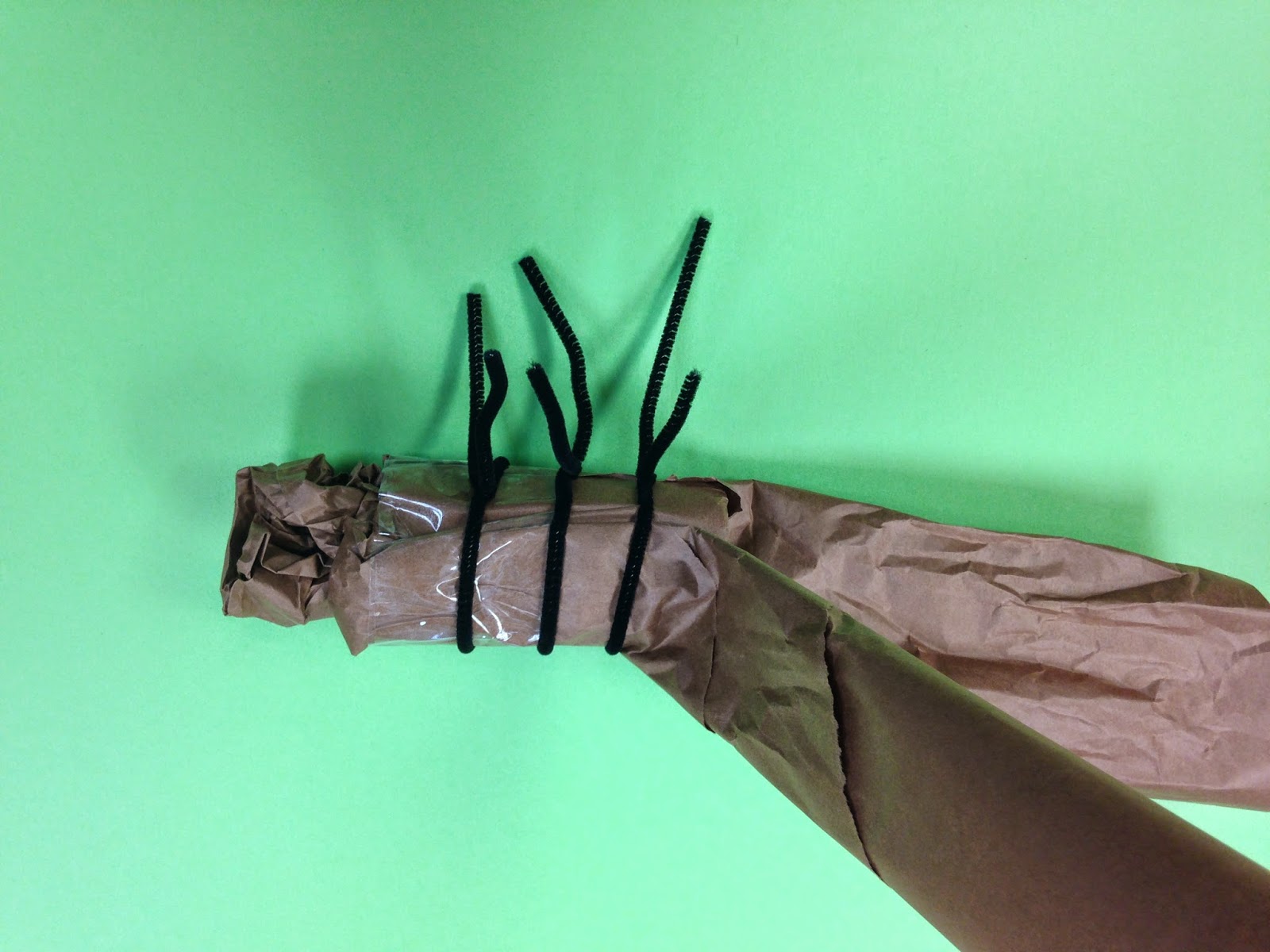
Materials needed: Brown butcher paper (approx. 2' x 3' for each child), a toilet paper roll, three black pipe cleaners, tape, black marker or crayon.
- Collect empty toilet paper rolls; one for each student.
- Tear about 8" x 8" of brown butcher paper to roll around toilet paper roll and stuff excess in each end. (No scissors or precise measuring needed for this project.)
- Tear two pieces of butcher paper (about 9" each) and roll diagonally into wings.
- Stuff 'wings' into the same end of 'body.' If it seems too tight or doesn't want to go in the paper roll, take the wings out, put your fingers in, and "smoosh" against the inside of the paper roll.
- Secure 'wings' with a wide piece of tape around the middle of the 'locust' at the insertion end of roll.
- Take about a 6" x 6" piece of butcher paper and roll into a ball for a head. (See above picture.)
- Insert 'head' into the same end of the paper roll the wings were inserted.
- Wind three pipe cleaners around 'body' and twist to secure, one at a time.
- Write "Locust - Plague #8" and "Exodus 10:1-20" on one wing.
- Draw big black eyes on head.