Saturday, June 20, 2015

Lesson - The Old Law Is Not Binding Today


VERSES:   Acts 15:1-41

MEMORY VERSE:  Acts 15:36  "...Let us go again and visit our brethren in every city where we have preached the word of the Lord and see how they do."

BOOK TO REMEMBER:   Review all the New Testament books that the students have been encouraged to memorize. This is a good foundation for memorizing the rest of the books.

PRAYER:   Pray that we always treasure the Bible, God's Word, and share it with others.

SPECIAL SONG:  Jesus Loves The Little Children (see February 2014 - Songs We Sing In Bible Class #2 on this blog. Click on orange circle to hear tune.)

VISUAL AID:  Bible map; Activity (see below)

LESSON POINTS:
  • When Jesus died on the cross, things had changed. No longer did Christians live under Moses' Law, but they lived under Jesus' Law. But some of the Christians who had been Jews and had lived under Moses' Law were having trouble understanding that Jesus had different rules.
  • While Paul and Barnabas were in Antioch, there were certain men who came down from Judea and were saying and teaching that Christians had to still follow the rules of the Old Testament in order to be saved and go to heaven. When Paul and Barnabas heard what the men were still teaching people, there were disagreements in the church when Paul and Barnabas told the men that the Old Testament laws did not apply to Christians. The men from Judea were very upset and made a plan for Paul, Barnabas and other men to go to Jerusalem and discuss this question concerning the Old Law with the apostles and elders.
  • Along the journey, the men continued to preach about Jesus to the Gentiles, bringing much joy to the cities of Phoenicia and Samaria. However, when they got to Jerusalem, there were some Christians, who had been part of the Pharisees group, who argued that parts of the Old Testament law were still binding.
  • The apostles and elders met together and discussed the problem. After much disagreeing, Peter finally stood up and said that a good time ago, God had chosen to include the Gentiles in hearing the Gospel and Peter was the one who had preached to them and they had believed and obeyed. Peter said that God had put no difference in the Jews and the Gentiles. 
  • The entire group was silent as Paul and Barnabas spoke to them about the miracles that they performed among the Gentiles. Afterwards, the men remained quiet. Then a man named James spoke up and, after he quoted scriptures, offered a wise solution. He suggested that they write letters to the Antioch, Syria, and Cilicia congregations, telling them that neither the apostles, nor the Holy Spirit, had given such a command to keep the Old Law. 
  • After the letter was written, Paul, Barnabas, a man named Judas and another man named Silas, who were prophets, were sent back to Antioch where the letter was read out loud to all the church. The letter caused great rejoicing among all the brethren. Judas and Silas encouraged the brethren there and, after the men had stayed a while, traveled back to Jerusalem, all but Silas, Paul, and Barnabas who stayed in Antioch and continued preaching.
  • After a few days, Paul suggested to Barnabas that they, once again, go on a second missionary journey and visit the churches where they had been before to see how they were doing. There was a disagreement on who should go with them on the journey. Barnabas wanted to take John Mark again, but Paul did not think that was a good idea since John Mark had left them in the middle of their last journey and did not work with them. They both felt very strongly about who should go, so, in the end, Paul and Barnabas went their own separate ways with Barnabas taking John Mark and Paul taking Silas.
"Older Student" Tips:
  • The Jews had lived by the Old Testament Law for hundreds and hundreds of years. When Jesus died on the cross, He took the Old Law away and put Jesus' Law into its place. We live under Christ's Law today. Christ died to sacrifice Himself once and for all (Hebrews 10:10) and, as an example, that is why we do not offer animal sacrifices as they did under Moses' Law. There is no need for animal sacrifices (Hebrews 10:4) because Jesus was the better sacrifice (Hebrews 9:13, 14, 22, 23). While change is sometimes difficult, we must always do just what the Bible says.
  • It is interesting to notice that, while Paul and Barnabas disagreed on who should travel with them on the beginning of a new second missionary journey, they worked it out without anyone stopping their preaching or going home. They continued to preach and teach about Jesus Christ, separately.
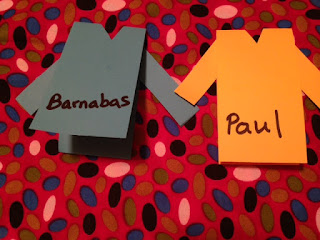
ACTIVITY:   Paul and Barnabas disagree
Materials needed:   9" x 12" light blue construction paper, stapler, staples, permanent marker (Be careful! Will be permanent on anything!), four strips 2 1/2" x 9" of different colored construction paper, four small strips of 1" x 7" matching different colored construction paper, glue, four plastic spoons, scissors.

  1. Hand out four spoons.
  2. With permanent marker, CAREFULLY draw face and hair on the back of each spoon.
  3. Set spoons aside.
  4. Hand out four 2 1/2" x 9" papers.
  5. Fold each paper in half.
  6. With scissors, cut a "V" in the middle of the folded edge. These are the four men's coats.
  7. Write a name--"Paul," Barnabas," Silas," or "John Mark"--on the bottom of the coat.
  8. Hand out four small strips of matching paper. These are the men's arms.
  9. Fold each small strip in half.
  10. Cut in half on folded line.
  11. Open up each coat.
  12. Place a small amount of glue on each side on the bottom half of paper near the fold line. (We are gluing the men's arms to the inside of their coats.)
  13. Fold coats in half again. 
  14. Staple each side of each coat.
  15. Insert one spoon with face in each coat.
  16. Hand out light blue paper.
  17. Fold almost in half.
  18. Staple of each side to form a pocket.
  19. Write "Paul and Barnabas disagree, but continue to preach the Gospel." and "Acts 15:36-41).
  20. Just before Bible class ends, the students places the four men in their light blue pocket and tells someone at home about the lesson.
  21. The Intent Of This Project:  Using the spoons, the students tell the story of how Paul and Barnabas wanted to choose their own helper (John Mark and Silas), but they disagreed about who to choose.  Barnabas wanted to take John Mark; Paul disagreed because of John Mark's history and wanted to take Saul. Finally, Paul took Silas with him and Barnabas took John Mark. Both men disagreed, but continued to preach the Gospel. It is possible to disagree with your brother and continue to teach and preach in harmony.

Lesson - "We Are Men Like You!"


VERSES:   Acts 14:1-28

MEMORY VERSE:   Acts 14:7  "And there they preached the gospel."

BOOK TO REMEMBER:   Colossians.  Write "Colossians" on small slips of paper, and hand out to the students at the end of Bible class.  By doing so, the student may memorize one more New Testament book in biblical order. Colossians is #12 of the New Testament books. Take a minute to review all the books that have been learned so far.

PRAYER:   Pray that we treat all people just the same and never treat anyone badly.

SPECIAL SONG:   Read, Read Every Day (see February 2014 - Songs We Sing In Bible Class #1 on this blog. Click on orange circle to hear tune.)

VISUAL AID:   Bible map; Large Activity (see below)

LESSON:
  • In the city of Iconium, Paul and Barnabas went together to the synagogue. The reason that both men went to the synagogue was that was where the people were! The people were already gathered together, so Paul and Barnabas did not need to invite or gather or round up people to listen to God's Word; they simply went to where the people were. In the synagogue in Iconium, not only were there Jews there, but also Gentiles. 
  • Jews had always heard the preaching of God's Word through their fathers, the prophets, and the judges, but Paul and Barnabas were preaching a different message than what they had heard before. They were preaching about Jesus. On the other hand, being accepted by God to hear His Word was something new to the Gentiles. God's chosen people had been the Jews for hundreds of years, but now that had changed (see June 2015 - Lesson - The Conversion Of Cornelius on this blog). The gospel of Jesus Christ--or the message of His life, death, burial, and resurrection--was now being preached to all people!
  • As Paul and Barnabas preached to the people about Jesus, a huge amount of the Jews and the Gentiles believed. But there were some of the Jews who did not believe and stirred up the Gentiles, influencing their minds in a bad way and undid the good that Paul and Barnabas had done.  Because of this, Paul and Barnabas stayed a long time and spoke boldly and unashamedly about Jesus. They even performed miracles to prove that they were sent from God, but the city was divided in their beliefs. Part of the people stayed with the Jews and part of the people stayed with the apostles. When Paul and Barnabas learned that the Jews and the Gentiles had plans to stone them, they fled to the cities of Lystra and Derbe which were not too far away in the region of Lycaonia. There, in Lystra and Derbe, they preached the gospel.
  • While Paul and Barnabas were preaching in Lystra, there was a man who had weak feet and had never walked before in his entire life, but there he sat, listening to Paul. Paul was looking intently at the crippled man and understood that the man had enough faith to be healed. With a loud voice, Paul said to him, "Stand up on your feet!" The man did not carefully, cautiously, or slowly get up and stand.. He LEAPED up and WALKED! 
  • When the people saw this man that they had known for a long time walk, they said in their own language in Lycaonia, "The gods have come down to us in the likeness of men!" They began to call Barnabas "Jupiter" and Paul "Mercurius." Both Jupiter and Mercurius were false gods of the city. The priest of Jupiter quickly began to bring oxen and garlands into the city, planning to offer sacrifices--not to God, but to Paul and Barnabas!
  • When the apostles, Barnabas and Paul heard about what was happening, they tore their clothes, which was a sign of grief, and ran in the middle of the people and cried out, "Sirs, why are you doing this? We are men just like you and we are preaching that you should turn from things like this and turn to the living God who made the heaven, earth, the sea, and everything that lives in them!" With these words, Paul and Barnabas persuaded the people not to offer the sacrifices to them.
  • Then, guess who showed up? The Jews from Antioch of Pisidia and Iconium. They took Paul and stoned him with stones. They dragged him outside the city of Lystra because they thought he was dead, but when the disciples stood all around him, he stood up and went back into the city. The next day, Paul and Barnabas went to the city of Derbe. (Show on map.) While they were in Derbe, they converted many people by preaching about Jesus. Then, Paul and Barnabas went back to the cities that they had already been--Lystra, Iconium, and Antioch--and strengthened the Christians there, encouraging them to continue in the faith. After they had ordained or appointed elders in every congregation of the Lord's church with prayers and fasting, they commended them to the Lord.
"Older Student" Tips:
  • Let's look on our Bible map. Where have Paul and Barnabas gone? They started in Antioch, sailed over to the island of Cyprus, went up to Perga, then to Antioch of Pisidia, Iconium, Lystra, and Derbe. That is quite a long trip! Paul and Barnabas went through many hardships, but they remained true to the Lord. When we have hard times in our lives, we should also trust in God to get us through just like Paul and Barnabas.
ACTIVITY:  "We are men like you!"
Materials needed:  9" x 12" tan construction paper, 2" x 12" black strip of construction paper,  4" x 9" tan construction paper, markers, tape, crayons, scissors.
  1. Hand out large tan paper. This is the background.
  2. Fold large tan paper, so that the edges meet in the middle.
  3. Draw one  3" lines on each fold in the middle of the tan paper.
  4. Open tan paper.
  5. At top of paper, write, "We Are Men Like You!" and "Acts 14."
  6. Draw many men around the tan paper, include the priest of Jupiter somewhere on the paper close to an ox with a garland.
  7. Color.
  8. Write "Priest of Jupiter" on the priest.
  9. Write "Ox" on ox or close by the ox.
  10. Write "Healed Man" on the man who could not walk. Student chooses which man is the healed man.
  11. Hand out smaller tan paper.
  12. Draw, color, and cut out Paul and Barnabas.
  13. Write "Paul" on Paul and "Barnabas" on Barnabas.
  14. Draw tear marks on Paul and Barnabas' clothing. It is fine to write the word "torn" with arrows on clothing.
  15. With scissors, cut on two black lines on folds. The Bible teacher may need to help some who cannot cut well.
  16. Insert black strip into cuts.
  17. On back, secure ends of black paper with tape.
  18. Attach Barnabas and Paul to the front of the black strip with glue or tape.
  19. Idea Behind This Project:  Just after the men of the city have called Barnabas "Jupiter" and Paul "Mercurius", Paul and Barnabas have torn their clothes in grief and have run among the people. Black strip may be moved GENTLY back and forth like Paul and Barnabas are running through the people, saying "We are men just like you! Turn to the living God!" The whole project can stand up on a table by simply re-creasing folds.

Tuesday, June 16, 2015

Lesson - Shaking The Dust Off Their Feet


VERSES:  Acts 13:14-52

MEMORY VERSE:  Acts 13:47   "...I have set thee to be a light of the Gentiles..."

BOOK TO REMEMBER:  Philippians.  Write "Philippians" on small slips of paper and hand out to the students, so they can memorize another New Testament book at home.

PRAYER:   Pray for boldness and confidence when talking to others about Jesus. May we never be ashamed of the gospel of Christ.

SPECIAL SONG:   No, Not One (see June 2014 - Songs We Sing In Bible Class #6 on this blog. Click on orange circle to hear tune.)

VISUAL AID:   Bible map; Large Activity (see below)

LESSON POINTS:
  • From Perga, Paul and Barnabas traveled to the city of Antioch of Pisidia and went to the synagogue. After the law was read, the rulers of the synagogue asked if anyone had an encouraging word to say to the people and Paul stood up and motioned with his hand for all to listen. He began preaching about God and children of Israel, He talked about King David and how he was a man after God's own heart. He spoke of John, the baptizer, and how he had not been the Christ. Paul preached for quite a while, and then began to preach about Jesus, God's Son, and how He rose from the dead. He preached about how the Gentiles could receive the forgiveness of sins through Jesus. 
  • When the Jews had left the synagogue, the Gentiles were eager to hear the Truth. They followed Paul and Barnabas and wanted them to preach to them on the next sabbath day. When the group of people was going in different directions, many of the Jews and others were persuaded by Paul and Barnabas to continue in the grace of God. 
  • The next sabbath day, almost the whole city came together to hear Paul and Barnabas preach the word of God. But something bad happened! When the Jews saw the huge crowds that had gathered together, they began to be envious or jealous. The Jews spoke against everything that Paul said! 
  • Paul and Barnabas spoke out boldly and told the Jews that it was necessary that God's Word was spoken to them first, but after the way they behaved and the  things they spoke against God's Word, then they were going to turn to the Gentiles and speak to them about the gospel. Paul and Barnabas said that the Lord had placed them to be a light to the Gentiles that salvation should be preached to the whole earth.The Gentiles were delighted to hear the word of God and many of them believed. The Word of the Lord was spread throughout the whole region. 
  • But, again, there was trouble! The Jews stirred up the devout women and the very important leaders of the city and did many unkind things to Paul and Barnabas. Finally, the Jews drove them out of the city of Antioch. Do you know what Paul and Barnabas did next? They shook the dust of their feet against them and moved on to the city of Iconium (see map). The disciples were not sad; they were filled with joy and with the Holy Spirit.
"Older Student" Tips:
  • Paul was not afraid to be in the synagogue with a great crowd of Jews. Paul and Barnabas took God's Word to where the people were gathered. Here in Antioch, the people were meeting in the synagogue. Notice what Paul did when he was asked if anyone had anything encouraging to say. He stood up with confidence and began to speak to the people about Jesus. Paul saw an opportunity and he took it! We should do the same.
  • In Matthew 7:6, we can read Jesus' words about what to do if people would not listen to God's Word and if they did not treasure the word of the Lord. The disciples were "not to cast their pearls before swine" or give the precious word of the Lord to people who did not care about God and His sayings. In Matthew 10:14, Jesus said if the anyone would not hear or listen to God's words, then they were to leave the city and shake the dust off their feet, moving on to another city who would hear them. This is what Paul and Barnabas did. The people wouldn't listen, so they left and shook the dust off their feet.
  • It is interesting to notice that Paul and Barnabas were not depressed or grieved about being kicked out of Antioch. What did they do? They were filled with joy!
ACTIVITY:  Shaking the dust off their feet
Materials needed: 9" x 12" tan construction paper,small amount of baby powder, markers, crayons, scissors.
  1. Hand out tan paper.
  2. Fold paper in half.
  3. Using most of the paper, draw one foot.
  4. Cut both feet out at one time.
  5. Outline feet with black marker, making one sandal on each foot.
  6. Color.
  7. One one leg, write "But they shook off the dust off their feet."
  8. On the other leg, write "Acts 13:14-52."
  9. Shake a SMALL amount of baby powder on each foot. This is the dust.
  10. The student may only "shake" off the dust once or twice before the powder is gone, so shake sparingly!

Monday, June 15, 2015

Lesson - The Missionary Journeys Begin!


VERSES:   Acts 13:1-13

MEMORY VERSE:   Acts 13:9  "And Saul (who also is called Paul)..."

BOOK TO REMEMBER:   Ephesians.  Write "Ephesians" on small slips of paper, so the students can memorize another New Testament book at home.

PRAYER:   Thank the Lord for the opportunities He gives us to tell others about His Son. May we pray that more opportunities would come our way.

SPECIAL SONG:   This Little Light Of Mine (see March 2014 - Songs We Sing In Bible Class #3 on this blog. Click on orange circle to hear tune.)

VISUAL AID:   Bible Map, tracing Paul and Barnabas' journey on the map.  Large Activity.

LESSON POINTS:
  • In the church at Antioch where Barnabas and Saul had been staying, there were others besides them who were teachers and prophets. A few others were Simeon, Lucius, and Manaen. While they did the Lord's work and fasted or did not eat any food for a time, the Holy Spirit spoke and said that he had work for Barnabas and Saul to do. When they had fasted and prayed and laid their hands on Barnabas and Saul, they sent the two men on a journey to tell others about Jesus. They began the first missionary journey at Seleucia and then sailed on a ship to Cyprus. (Show on map.) 
  • Because people back in those days had no cars, trains, or airplanes, their journeys were long and hard. They either rode on an animal, sailed on a ship, or, most often, they walked. Their journeys took many days, weeks, months, and sometimes longer. They would go to where people would meet, such as market places, people's houses, or in the synagogues. On the island of Cyprus and in the city of Salamis, Barnabas and Saul preached to the people in the synagogues. John Mark, who was a younger man and some say was related to Barnabas was also with them and helped them.
  • When they had traveled through the island to a city called Paphos, Barnabas and Saul found a man there who was a Jew and was a sorcerer or someone who did magic tricks. He was called a false prophet because he pretended to be from God, but only tricked the people and could not do any miracles from God. The man's name was Barjesus, but he was mostly called by the name of Elymas in this lesson. Elymas traveled with a very important man, Sergius Paulus, who was the deputy of the country and a very wise man. 
  • Sergius Paulus wanted to hear the Word of God, so he called for Barnabas and Saul to come to him, but Elymas resisted Barnabas and Saul. He did not want Sergius Paulus to listen to God's Word. He wanted to turn Sergius Paulus away from the faith. 
  • Then Saul, who was also called Paul, was filled with the Holy Spirit, fixed his eyes on Elymas and said to Elymas, "You who are filled with trickery and all mischief, you child of the devil and enemy of everything right, will you not stop making something evil out of the right ways of the Lord? Watch, because now the hand of the Lord is on you, and you shall be blind and will not see the sun for a season!" Immediately, a mist and darkness fell upon Elymas and he went around looking for someone who would lead him by the hand. When the deputy saw what had been done to Elymas, he believed and was amazed at the teaching of the Lord.
  • When Paul and the men who traveled with him left Paphos, they went to a city in Pamphylia called Perga. It was here that John Mark left them and went back to Jerusalem. (Show on map.)
"Older Student" Tips
  • Many of the apostles and Christians fasted, and when they fasted, they prayed as well. Fasting means that they did not eat food for a time. They were devoting their time to praying to God.
  • Remember miracles were performed to prove that those who performed them were from God. Elymas was a false prophet because, though he claimed to be a prophet, he could do no miracles, proving he was not from God.
  • It is interesting to notice that Saul, now called Paul, did not hesitate to rebuke or scold Elymas for the mischief he had made. He called Elymas a child of the devil because he was getting in Sergius Paulus' way of hearing God's Word.
  • Saul has his name changed on the island of Cyprus to the name "Paul." Paul means "little one" which is a name of humility. When we think of the name 'Saul' , we think of an important Jew who persecuted Christians, however, now the humble name of 'Paul' makes one think of a preacher of the Gospel who will be subjected to many hardships as a Christian.
ACTIVITY: Elymas Goes Blind
Materials needed:  9" x 12" tan construction paper, 4" x 12" black construction paper, 4" x 8" wax paper (or netting or clear sparkle paper), markers, crayons, staples, stapler,.


  1. Hand out tan paper.
  2. Draw picture of Elymas and Saul looking at each other.
  3. Color the two men.
  4. Above Elymas' head, write "Elymas".
  5. Above Saul's head, write "Saul", then cross out the "S" with a red crayon. Write a "P" close by the word "Saul."
  6. Draw a small arrow from the word Elymas to the picture of Elymas.
  7. Draw a small arrow from the word "Paul" to the picture of Paul.
  8. On the edge of the paper close to Paul, write "Filled with Holy Spirit."
  9. On the edge of the paper close to Elymas, write "Withstood Paul and Barnabas."
  10. In the middle of the words "Elymas" and "Paul", write the word "AND".
  11. Below the word "and", write "...and now, behold, the hand of the Lord is upon you, and you shall be blind, not seeing the sun for a season." Draw a line all around the words, beginning close to Paul's mouth and ending close to Paul's mouth. This is a speech bubble.
  12. Below the speech bubble, write, "Immediately, a mist and a darkness feel on him and he went about seeking someone to lead him by the hand/" Also, write, "Acts 13:1-13."
  13. Hand out wax paper. This is the mist.
  14. Write the word, "mist" at the bottom of the wax paper.
  15. Hand out black paper.
  16. Write the word, "DARKNESS" across the front of the black paper.
  17. Place the wax paper over Elymas' face, folding excess wax paper to the back of the tan paper.
  18. Place black paper over the mist, completely covering Elymas, folding the excess wax paper and black paper to the back of the tan paper.
  19. Staple both papers at the top of the tan paper. The Bible teacher may need to help small hands.
  20. Fold both the wax paper and the black paper to the back of the tan paper until ready to tell that part of the lesson.
  21. Re-tell the story with all the students, covering Elymas first in the mist, then in darkness. 

Tuesday, June 9, 2015

Extra Helps #15 - Learning With Maps


As we begin the missionary journeys of Paul, the students will occasionally be drawing maps. It is helpful to know where Paul went on his journeys, so we become familiar with the towns and cities, areas and provinces in which he traveled. It is interesting to follow his footprints as he preached through the land. Some say that by studying maps, it helps the lands become a little more real in the students' minds. True or not, it cannot hurt studying where those of old lived their lives, how they preached about Jesus Christ, and learn how and where the church grew as the Word spread.

There are different ways to teach students through map-making. Here are just a few to consider:
  • Large Bible maps may be hoisted up on stands or applied to the walls and displayed in the Bible classroom. This can create great interest in young minds. Perhaps you have an overhead projector (see March 2014 - Visual Aids - #4 Overhead Projector on this blog) and are able to trace or draw large maps on butcher paper, chalking the different areas with colorful chalk, and laminating the maps so they will be protected for a long time. Having one of these extra large hand-drawn maps stapled on the classroom wall is quite impressive. One can tell that the Bible is being taught in that particular classroom, students are eager to learn where they will travel during the next lesson, and there is much to be learned. Small footprints can be pinned or taped to the map and can be connected to other cities as lessons are studied each week. When Paul boards a ship and travels to the next country, a small cut-out ship could be added to the Mediterranean Sea, showing which way Paul traveled. Or, pieces of yarn may be attached with pins, noting the cities where Paul preached.
  • Students may draw their own maps for that day's lesson and add the map to a special personal folder, accumulating the maps of Paul's four missionary journeys. There is no need for the maps to be perfectly drawn. An illusion is all that is necessary. Details such as cities, names of seas, etc. may be added.
  • The students may draw one map of the areas from Italy to Egypt to Palestine and staple the map to a bulletin board that has been prepared in advance. As the students study a particular chapter in the book of Acts, simply add the cities or areas mentioned in that chapter. Continue until the books of Acts has been completely studied. The maps should look extremely detailed.
Whatever your chosen method is of studying the missionary journeys, adding maps can only complete a thorough study. Where interest is nurtured, students learn.

Monday, June 8, 2015

Lesson - An Angel Helps Peter Escape


VERSES:  Acts 12:1-25

MEMORY VERSE:   Acts 12:24   "But the word of God grew and multiplied."

BOOK TO REMEMBER:   Galatians.  Write "Galatians" on small slips of paper and hand out to the students at the end of the class, so they may memorize this new book at home.

PRAYER:  Always remember to pray for those in need, those in prison, those in troubled lands, those who are sick or have no food. When we cannot help in any other way, we can always pray.

SPECIAL SONG:  Read, Read Every Day (see February 2014 - Songs We Sing In Bible Class #1 on this blog. Click on orange circle to hear tune.)

VISUAL AID:  Large Activity (see below)

LESSON POINTS:

  • Soon, Herod, the king, began to persecute the Christians even more. When he killed John's brother, James, and saw that it pleased the Jews, he arrested Peter and put him in prison. King Herod assigned 16 soldiers to guard Peter at different times of the day, so there was never a time when someone was not watching him or was not with him. Since it was the feast days of unleavened bread, King Herod's plan was to bring Peter before the people after the Passover was over. 
  • But, one thing that King Herod did not count on was prayer. All the time that Peter was kept in prison, the church prayed for him. They prayed for him in the morning. They prayed for him in the afternoon. They prayed for him in the evening. They prayed for him at night. They prayed for Peter all the time. God was listening.
  • The night before Herod was going to bring Peter out to the people, Peter was chained to two soldiers with two chains. He was sleeping between them and there were two soldiers guarding Peter's door. They wanted to keep Peter right where he was--in prison! But God had another plan for Peter.
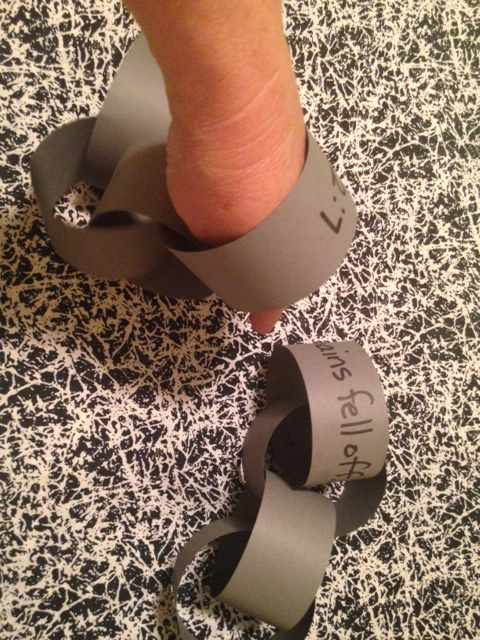
  • That night an angel of the Lord came to Peter and a light shone in the prison. The angel hit Peter on his side and woke him up. The angel said, "Get up quickly!" All of Peter's chains fell off his hands. Then the angel said to put on his sandals and Peter did.  Then Peter was told to throw his coat over him and to follow the angel. All this time, Peter didn't know he was really moving and doing what the angel told him to do. He thought he was seeing a vision, but he followed the angel of the Lord and did exactly as he was told. When they went through the first and second guards, they came to the iron gate that led into the city. The iron gate opened all by itself! Peter and the angel went on through it and out into the street of the city and the angel disappeared.  That was the moment that Peter knew that it was not a vision, but that the angel of the Lord had really helped him escape from the prison! He knew that God had sent His angel to deliver him from Herod.
  • After he had thought about what he was going to do next, Peter decided to go to John Mark's mother's house and many were still there praying for Peter. When Peter knocked on the door of the gate, there was a young girl named Rhoda who answered. She knew Peter's voice and was so happy that, without opening the gate, she ran into to tell everyone that Peter was outside. They thought she was crazy, but she kept telling them that it was really Peter. They said it was Peter's angel, but Peter kept on knocking outside on the door of the gate. When they opened the door and saw that it was truly Peter, they were amazed! Peter, motioning with his hand to be quiet and he told them all of the things that had happened to him. He told them to go and tell the others and he went to another place.
  • As soon it was daylight, there was quite a commotion in the prison! The soldiers had no idea what had become of Peter because they could not find him! They knew what would become of them if Peter was not found. After Herod had diligently looked for Peter and could not find him, he brought all the soldiers that were supposed to be guarding Peter and killed them. Being a guard was a very important job and they had failed to keep their prisoner in the prison.
  • Herod decided to go from Judea to the seaside where Caesarea was and stay. The people there celebrated Herod and made him feel special. They set aside a day to honor Herod. Herod had beautiful clothes to wear, he sat on a throne, and he made a very long speech. When the people heard Herod's speech, they shouted to Herod, "This is the voice of a god, not a man!" Because Herod did not disagree with the people and did not give God the glory, the angel of the Lord immediately struck Herod with worms that ate him up and he died. That was the end of that Herod!
  • But nothing man could do could stop the Word of God. God's Word grew and multiplied. Barnabas and Saul returned from Jerusalem and took with them John Mark--whose mother's house the Christians had been inside, praying for Peter.

"Older Student" Tips:

  • The church we read about in the book of Acts was a praying church. They prayed for important things to happen and God listened to their prayers. If we are doing those things that are right and what pleases God, He will listen to our prayers, too. But, we know that the face of the Lord is turned against the ones who do evil and He will not listen to their prayers. Read 1 Peter 3:12, Psalm 34:15, 16 and John 9:31 .
ACTIVITY:   Peter's Chains
Materials needed:  12" x 16" gray or silver construction paper, tape, scissors, marker, crayons.
  1. Hand out gray paper.
  2. Width-wise, cut in eight 2" strips.
  3. On one strip, write "Acts 12:7."
  4. With the two ends of the paper meeting in the middle, secure with tape. This strip should be formed like a circle. These are the links in two chains.
  5. Insert a second strip in the middle of first circle.
  6. Secure with tape.
  7. Insert a third strip through the second circle.
  8. Secure with tape.
  9. Insert a fourth strip through the third strip.
  10. Secure with tape.
  11. Set this chain aside.
  12. On another strip, write "...And his chains fell off..."
  13. Insert a second strip in the middle of first circle.
  14. Secure with tape.
  15. Insert a third strip through the second circle.
  16. Secure with tape.
  17. Insert a fourth strip through the third strip.
  18. Secure with tape.
  19. Slip one of the end links onto the student's hand.
  20. Slip one of the end links of the second chain onto the student's other hand.
  21. The Bible teacher reads Acts 12:7 out loud. When the words "And his chains fell off" is read, all students' chains fall off of all wrists. (It's a beautiful moment!)
  22. Repeat until class time is over or the students tire of the exercise.  

Sunday, June 7, 2015

Lesson - Called By A New Name


VERSES:   Acts 11:19-30

MEMORY VERSE:   Acts 11:26  "...And the disciples were called Christians first in Antioch."

BOOK TO REMEMBER:   Review the first eight books of the New testament, making certain that all students have a firm handling of the names of the books and can say them in Biblical order.

PRAYER:   Thank God for His plan of salvation and that the Gospel is for all people. Thank God that we can worship him freely and not be afraid.

SPECIAL SONG:   How Do Christians Worship God?  (See May 2014 - Songs We Sing In Bible Class #5 on this blog. Click orange circle for tune.)

VISUAL AID:  Bible map show, showing Jerusalem, Phoenicia, Cyprus, Antioch, Tarsus, Judea. Large Activity (see below)

LESSON POINTS:  
  • In many countries today, there is religious freedom and people can worship God freely. This has not always been the case. Ever since Stephen had been stoned for preaching about Jesus and had died, the church was persecuted. (See May 2015 - Lesson - The Stoning Of Stephen). We remember that even Saul helped in this persecution before he was baptized (Acts 8:1, 3).
  • Because of the church being persecuted, the believers in Jesus scattered to escape the bad things that were happening in Jerusalem. When we look on the map (show Bible map), the disciples scattered from Jerusalem to Phoenicia, Cyprus, and Antioch. The ones who went to these cities only preached to the Jews. We learned when Cornelius was baptized into Christ and that he was the first Gentile (or non-Jewish) person that had been preached to and obeyed the gospel. We remember that Peter preached to him and all of his family and friends and many were baptized because of Peter's preaching. (See June 2015 - Lesson - The Conversion of Cornelius on this blog.) From that time until now, the gospel is for ALL people, Jews and Gentiles.
  • Some of the disciples were from Cyprus and Cyrene and, when they came to the city of Antioch, they preached about Jesus to the Grecians and a great number of people believed and turned to the Lord. When the church in Jerusalem heard about what was happening in cities far away from Jerusalem, they sent Barnabas to help and preach to them.
  • Do we remember anything about this man named Barnabas? When Saul escaped from Damascus by being let down the wall in a basket and went to Jerusalem, all the disciples were afraid of him. They thought he was still persecuting Jesus' disciples. But who stood up for Saul and took him to the apostles and gave Saul the opportunity to tell them how he had spoken to Jesus on the road to Damascus? Barnabas! Barnabas had not been afraid of Saul and was Saul's friend. So now, it was this same man, Barnabas who was sent by the church to go preach about Jesus to the ones in Antioch and all along the way. Barnabas preached to many people and they were baptized and added to the church. 
  • Do you know what Barnabas did next? He traveled to Tarsus and looked for his friend, Saul and brought him back to Antioch, too! They stayed in Antioch for a whole year, worshiped with the church, and taught many people about Jesus. It was here in Antioch that the disciples were called by a new name. They were called Christians. 
  • When a man named Agabus was filled with the Holy Spirit and foretold of a terrible famine that would be coming in the days of a Caesar named Claudius, the disciples sent Barnabas and Saul with money to give to the brethren who lived in Judea for this coming disaster. 
"Older Student" Tips:
  • Just as the believers and disciples of Jesus were called Christians in the book of Acts, people who have 
    • heard the Word (Romans 10:17), 
    • believed in Jesus (Acts 8:13), 
    • repented of their sins (Acts 2:38), 
    • confessed Jesus as the Christ (Acts 8:37), 
    • and are baptized for the remission of their sins (Acts 8:38, 39) are called Christians today. 
  • This lesson tells us why Christians are called 'Christians.' It is not a made up name or a name that men have voted among themselves to called; it is a name that was in God's mind and in His plan. There is book, chapter, and verse for believers in Christ to be called "Christian." Read Acts 11:26 again.
  • In Isaiah 56:5 and 62:2, Isaiah foretold the time when believers would have a new name. In Acts 11:26, we find out that new name: Christian. 
  • The word Christian is only found three times in the Bible. Acts 11:26, Acts 26:28, and 1 Peter 4:16.
ACTIVITY:  A New Name
Materials needed:  9" x 12" black construction paper, 4 1/4" x 8 1/2" white bond paper (this is a half-sheet of typing paper), 2" x 7" yellow construction paper, scraps of different colored paper, scissors, markers, crayons, glue.

  1. Hand out black paper.
  2. Fold black paper in half.
  3. Turn black paper, so that the long, open sides are at the bottom and fold is at the top.
  4. Hand out yellow paper.
  5. Write "A NEW NAME" and "Acts 11:26" on yellow paper.
  6. Glue yellow paper to front of black paper.
  7. Unfold black paper.
  8. Hand out different colored scraps of paper.
  9. On nine different colors of scrap paper, write "...And," "the," "disciples," "were." "called," "Christians," "first," "at," "Antioch."
  10. Assemble the words on the black paper in order.
  11. Glue the words to the black paper.
  12. Re-fold black paper and turn the paper over to the back side.
  13. Hand out white paper.
  14. Show students how to draw a very rough outline on the white paper.  Or copy the outline below and hand out to students.  This outline does not need to be perfect; it only needs to show the highlighted areas on the map.(Don't forget the island of Cyprus!)
  15. Write "Mediterranean Sea." "Tarsus." "Antioch," "Phoenicia," "Jerusalem," and "Cyprus" in proper areas. It is OK to look at the Bible map in a Bible.
  16. Color map.
  17. Glue map to back of the black paper.
  18. Before students leave the classroom, make certain the words are glued in order inside the black paper and the cities and areas are in the right places on the map.

Wednesday, June 3, 2015

Lesson - The Conversion Of Cornelius


VERSES:   Acts 10:1-48

MEMORY VERSE:   Acts 10:48   "And he commanded them to be baptized in the name of the Lord..."   

BOOK TO REMEMBER:  2 Corinthians.   Write "2 Corinthians" on small slips of paper and hand out to the students before they leave class, so they can memorize one more New Testament book.

PRAYER:   Pray that we treat all people as we would want to be treated, not thinking that we are better than anyone else. God created us all the same and we should love one another.

SPECIAL SONG:   God's Good Menu (see May 2014 - Lesson - Menu Rules on this blog. Click on orange circle to hear tune.) This song tells what animals God's people could and could not eat. God's food rules change on the blog tonight.

VISUAL AID:  A sheet with animals made of plastic, paper, wooden. Sometimes inexpensive plastic toy animals are found at Dollar Tree, Walmart and such like. If no animals are available, print or draw colorful pictures of four-footed animals, wild beasts, creeping things, and birds..These animals should be ones that Jews could not eat before this event.(see May 2014 - Lesson - Menu Rules.)  With the animals in the middle of the sheet, hold the four corners of the sheet together high in the air. As you let down the sheet to the ground, let the students take a look inside the sheet.

LESSON POINTS:
  • There was a man who lived in Caesarea whose name was Cornelius. Cornelius was a soldier who ruled over 100 other soldiers. He was a devout man. He had respect for God; in fact, his whole household had respect for God. He gave a lot of money to the poor people. Cornelius always prayed to God. Cornelius was not a Jew, but he had favor with all of the Jews (Acts 10:22). Anyone who was not a Jew was called a Gentile. Cornelius was a Gentile.
  • One afternoon, Cornelius saw an angel of God coming to him in a vision.  The angel said, "Cornelius." When Cornelius looked at the angel, he was afraid and asked, "What is it, Lord?" The angel went on to say to Cornelius, "Your prayers and what you do for the poor come to God as a memorial." That meant that God was pleased with Cornelius! The angel told Cornelius to send men to Simon Peter who was staying with a man also named Simon who was a tanner and lived by the sea in the city of Joppa. The angel said that Peter would tell him what to do.
  • The minute the angel left, Cornelius called two of his servants and one of his devout soldiers who was close to Cornelius and told them what had happened and what they were to do. The three men hurried to Joppa to find Peter.
  • The next morning as Cornelius' men traveled to Joppa and were very close to the city, Peter went up on the housetop to pray. Peter was very hungry, and while they were getting the food ready to eat, Peter fell into a trance. He saw the heaven open, and something like a sheet of fabric gathered at all four corners came down from heaven. Then, a voice spoke to Peter and said, "Get up, Peter, kill and eat." But, Peter knew that God did not allow His people to eat just any animal (see May 2014 - Lesson - Menu Rules.) In the book of Leviticus, God told Moses what the people could eat and not eat for their own good. For example, the people could not eat pork, or birds that ate dead things. But, in the New Testament, as we see in our lesson today, God changes His rules for what people could eat and not eat. 
  • When Peter was told to eat the animals that were in the sheet, he said that he could not because he had never eaten anything unclean or common. The voice spoke to Peter the second time and told him that what God had cleansed, do not call it common. This was done three times and then the sheet was taken back up into heaven.
  • As Peter was wondering what this vision meant, there was a knock at the gate. It was the men who were sent by Cornelius! While they were asking if Peter was there, the Spirit talked to Peter and told him that there were three men looking for him. The Spirit told Peter to go down to the men, because he was on the roof top, and go with them. He was not to doubt because the Spirit had sent them. So Peter went down from the roof top and spoke to the three men. He said, "I am the one you have been looking for. Why did you send for me?"  Then they told Peter about how a holy angel from God had spoken to Cornelius and told him to listen to Peter's words.
  • So, the men stayed the night at Simon the tanner's house, and the next morning, Peter and six disciples from Joppa went to Caesarea to Cornelius' house (Acts 11:12). The following day, when Cornelius heard that Peter and men were coming, do you know what he did? He invited all of his relatives and friends to his house where they waited for Peter to arrive. When Peter was coming into the house, Cornelius fell down at Peter's feet and worshiped him, but Peter told him to stand up because he was a man, too. As Peter entered the room, he saw that there were many gathered together. He said to Cornelius and his friends that he knew it was against the law for a Jew to keep company with one of another nation, but then he told them what he had learned from his vision. He said that God showed him that he could not call any man common or unclean, and then he asked why Cornelius had sent for him. Cornelius told Peter about his own vision and how the angel had told him to send for Peter, so he could listen to his words.
  • Peter then opened his mouth and preached to the first Gentiles about how God was not a respecter of persons, or God now treated everyone the same if they respected God and did righteously or obediently. Peter said that if whoever did those things, God would accept them. Then Peter started preaching about Jesus and how He died, but was raised to life again. He told Cornelius and his friends that whoever believed in Jesus would receive the forgiveness of their sins.
  • Then, while Peter was still preaching, the Holy Spirit fell on those who were listening to Peter. Cornelius and his friends were speaking different languages that they had not learned. They were all amazed that this had happened because up to this point, the Holy Spirit had not been given to any Gentile! Peter told the people, "Can we forbid water that these people who have received the Holy Spirit like we have should not be baptized?" Then Peter commanded that they should all be baptized and Peter baptized them.
  • Peter stayed in Joppa for a few days.
"Older Student" Tips:
  • God does not speak through visions and trances today because we have the Bible written down and we are able to check out what truth is by reading God's Word, the Bible. Since the Bible is here now, God does not need to speak any other way than in His Word.
  • How did the Jews who had been baptized into Christ react to the Gentiles also being added to the church through baptism? The Jews had been God's chosen people for hundred of years and to accept the obedient Gentiles as being God's people, too, was difficult for some of the disciples to understand. The apostles and brethren in Judea heard that the Gentiles had received God's Word and when Peter went to Jerusalem, they wanted to know how it had happened. (Acts 11:1, 2). Peter explained everything just the way it had happened (Acts 11:3-17), and the disciples finally accepted the fact that anyone who obedient to God's Word could be saved, not just one group of people (Acts 11:18).  
ACTIVITY:  The Gospel Is Preached To Cornelius, The First Gentile Baptized
Materials needed: 9" x 12" tan construction paper, crayons, marker, scissors.
  1. Hand out tan paper.
  2. Fold edges to the middle of the paper.
  3. Crease folds.
  4. Open paper.
  5. In large middle section, write "Cornelius" ans "Acts 10" at the top of the paper.
  6. Draw a picture of Cornelius in his soldier uniform. 
  7. Color.
  8. On the left and right sections, write facts that are known about Cornelius, drawing a line between facts. For example:  Lived in Caesarea, A soldier-ruled over 100 soldiers, A devout man, Feared God, Gave money to poor, Prayed to God always, Baptized, First gentile in church.
  9. Cut on lines.
  10. Fold all facts to the back of the middle section, so the facts are hidden.
  11. As a friend of the student begins guessing as many facts as they can remember about Cornelius, the student unfolds the correct responses that are given. In the end, all facts should be in view.
  12. Purpose of this project:  To help students remember as many facts as they can about Cornelius and what book and chapter his story is told in the New Testament. 
  13. Before leaving class, make sure all the facts are hidden behind Cornelius!