Tuesday, November 11, 2014

Lesson - Jonah And The Great Fish


VERSES:   Jonah 1:1-4:11

MEMORY VERSE:   Jonah 1:17  "Now the LORD had prepared a great fish..."

BOOK TO REMEMBER:   2 Peter.  Write "2 Peter" on small slips of paper and hand out to 

PRAYER:   Pray that we obey God the first time He tells us something through His Word. We, like Jonah, will save ourselves a whole lot of trouble.

SPECIAL SONG:   Jonah (see March 2014 - Songs We Sing In Bible Class #4 on this blog.  Click on the orange circle to hear tune.)

VISUAL AID:   Cast lots to demonstrate what that meant back in Jonah's time. Make a large Activity (see below).

LESSON POINTS:
  • Jonah was a minor prophet who wrote a book that bore his name with only four chapters. Jonah was from Gathhepher which was twelve miles west of the Sea of Galilee. He was, also, the son of Amittai.
  • God spoke to Jonah and told Jonah to go to Nineveh and preach to the people and tell them to repent of their wicked ways, but Jonah chose to run away to Tarshish. He traveled to the city of Joppa and found a ship that was going to Tarshish, which was in the opposite way of Nineveh. He paid for his ticket and went down into the ship.
  • But God sent a great wind into the sea, so that a strong storm almost broke the ship in half! The sailors on the ship were afraid and cried out to their gods. They threw things on the ship overboard to make the ship lighter, so that they might not wreck the ship.
  • Where was Jonah all during this time? He had gone down into the inside of ship, had laid down...and went to sleep. The captain of the ship came into where he was sleeping and said to him, "Why are you sleeping? Get up and cry to your God, so that we will not die!" Then the other sailors decided to cast lots or what we call 'draw straws' to see who was causing trouble on the ship. When the lot fell to Jonah, the sailors asked him where he came from, what did he do for a living, and what nationality he was. Jonah confessed that he was a Hebrew who feared the LORD God who had made the land and the sea. 
  • The men were very afraid! They asked Jonah why he had done this to them because knew he had run away from the LORD. They asked what they should do to him in order to calm the sea because the sea was tossing to and fro. Jonah knew what to do. He told the sailors to throw him into the sea, then the sea would be calm. Jonah said he knew that he was the one who was causing the trouble. But the men even rowed harder to reach the land, but they could not because the sea was very stormy. They prayed to God to spare their lives and, finally, they took Jonah and threw him into the ocean and immediately the sea was calm which made the men honor the LORD God.
  • While all this was happening, the LORD had prepared a great big fish that swallowed Jonah up. Jonah was in the belly of the fish for three days and three nights. Then Jonah changed his mind and prayed to God. Jonah chose to do what God said. Jonah chose to go to Nineveh. Do you know what happened then? God spoke to the fish and the fish spit Jonah out on dry land! Jonah could have saved himself a whole lot of trouble if he had obeyed God in the beginning and preached to Nineveh.
  • God told Jonah again to go to Nineveh and preach to the people and tell them to repent and stop doing the wicked things that they had been doing. Jonah walked all around the city and the city was so big that it took him three days to walk all around it! As he walked, Jonah cried out loud and said, "Forty days and the city of Nineveh would be overthrown!" The people heard Jonah and believed God. They proclaimed a fast and everyone, even the very old people to the very young children put on sack cloth and they did not eat anything. Even the king of Nineveh heard the word and he covered himself with sackcloth and ashes. Everyone repented of their sins and cried mightily to God to forgive them.
  • When God saw that Nineveh had truly repented and turned from their evil ways, God changed his mind and spared the city of Nineveh from destruction. Jonah had helped the city and obeyed God. 
"Older Student" Tips:
  • Sometimes Jonah is called the "Running Prophet" because in Chapter 1, Jonah was running from God, in Chapter 2, Jonah was running to God, in Chapter 3, Jonah was running with God, and in Chapter 4, Jonah was running against God.
  • The rest of the story:  After the city repented, Jonah was very displeased and angry. Jonah said that he knew that God was merciful, gracious, slow to anger, and was full of kindness, but the reason that Jonah had run away in the beginning was because Jonah was a patriotic man and he had wanted Nineveh to be destroyed. Now that Nineveh had repented of their sins, he was angry and wanted to die. The LORD scolded Jonah and Jonah went outside the city and made a little booth or a lean-to and sat in its shade to see what was going to become of the city. The LORD cause a gourd to grow right over Jonah's head, so that it shaded Jonah's head to help him with his grief. Jonah was very glad to have the gourd grow, but the next morning, God prepared a worm that made the gourd wither and die. Then, God prepared a strong east wind to cause the sun to beat down on Jonah's head. Jonah fainted and wished he could die. He was acting like a spoiled child, wasn't he? God asked Jonah if he was angry because the gourd withered and Jonah said he was. Then God told Jonah that he had pity on the gourd that he himself had not worked to make it grow, yet when it died, he was angry. God asked Jonah if God should have spared the city of Nineveh that had 120,000 little children. That is where the book of Jonah ends and it does not say whether Jonah repented or not, but we must consider that Jonah did write and finish his book.
  • Jonah did no miracles in the whole book because HE was the miracle. 
  • No one knows where Tarshish was, but somewhere over by Spain.
  • Real lesson of the book of Jonah:  We know our God (Jonah 4:2). God had patience with Jonah and Jonah felt like he could honestly talk to God.
  • It is interesting to notice that in Jonah 2:6, it says that "Jonah went down to the bottom of the mountains" in the sea. How did Jonah know that? Inspiration from God!
  • Jesus believed in Jonah's story because he refers to Jonah in Matthew 12:38-41.
ACTIVITY:   Jonah And The Great Fish
Materials needed:   12" x 18" dark blue construction paper, 4" x 18" medium blue construction paper, 3" x 18" litle blue construction paper, 12" x 12" black construction paper, 4" x 12" brown construction paper, scraps of orange, black, tan, and green paper, marker, crayons, glue, scissors.

  1. Hand out darkest blue paper.
  2. Hand out light blue paper.
  3. Glue light blue paper to the very top of the dark blue paper.
  4. Hand out medium blue paper.
  5. Glue medium blue paper just under the light blue paper.
  6. Hand out brown paper.
  7. Round bottom corners of brown paper or cut at an angle.
  8. Glue brown paper to top edge of light blue paper. This is the boat.
  9. Draw 'wood' on boat. (see picture).
  10. Hand out black paper.
  11. Fold black paper in half.
  12. Draw a big fish with top of fish on fold line.
  13. NOT CUTTING ON FOLD, cut fish out. 
  14. Glue the black fish's BACK in the middle of the dark and medium blue paper.Fish should open up.
  15. Out of tan scraps, draw Jonah.
  16. Cut Jonah out.
  17. Color Jonah.
  18. Glue Jonah INSIDE the black fish.
  19. Out of black scraps, cut out black rock.
  20. Glue to bottom of picture.
  21. Out of tan scraps, cut or tear out dirt.
  22. Glue dirt to bottom of picture.
  23. Out of green scraps, cut out seaweed.
  24. Glue seaweed to paper.
  25. Out of orange scraps, cut out little fish.
  26. Glue orange fish in seaweed, saving one fish.
  27. Draw an 'x' on the saved orange fish's body where the eye should go. This fish is dead.
  28. Glue dead fish inside the black fish with Jonah.
  29. Glue tiny bits of green seaweed inside the black fish with Jonah.
  30. Draw eye and gill on black fish.
  31. Write "So they took up Jonah, and cast him forth into the sea..." and "Jonah 1:15" on the top right of the boat.
  32. Write "Now the LORD had prepared a great fish to swallow up Jonah..." close to the black fish.
  33. Open up black fish.
  34. On the inside of the top fish, write "And Jonah was in the belly of the fish three days and three nights..." and "Jonah 1:7).

Sunday, November 9, 2014

Lesson - Obadiah


VERSES:   Obadiah 1:1-21

MEMORY VERSE:  Obadiah 1:3  "The pride of thine heart hath deceived thee..."

BOOK TO REMEMBER:  1 Peter.  Write "1 Peter" on small slips of paper and hand out to students at the end of class.

PRAYER:   May we all be humble and help others as we see the need.

SPECIAL SONG:   Be Patient And Kind (see April - Lesson - Joseph Meets His Brothers Who Hated Him on this blog)

VISUAL AID:   White board or Chalkboard Drawing of Activity below

LESSON POINTS:

  • Like Hosea, Joel, and Amos, Obadiah was also a minor prophet because the book that Obadiah wrote only has one chapter! Obadiah is the shortest book in all of the Old Testament! Other prophets like Isaiah, Jeremiah, Ezekiel, and Daniel wrote more, so they are considered major prophets.
  • We don't know a lot about Obadiah. There is not a lot of information on his personal life  just like Joel. 
  • Obadiah wrote his book about the judgment of Edom. Edom was a nation that was made up of Esau's descendants. Do we remember who Esau was? That's right! He was Jacob's twin brother who gave up his birthright and was tricked out of his blessing by Jacob (see April - Lesson - Jacob and Esau and April - Lesson - Jacob And The Blessing on this blog). As Esau's family grew and grew and grew, it became the nation of Edom.
  • When Obadiah preached to Edom, it was not good news. Edom had a big problem as far as God was concerned, and that was with Edom's PRIDE. 
    • Edom had too much pride concerning the place where they lived among the high clefts of the rocks. 
    • They had too much pride in the the power they believed they had. They believed they did not need God; they could do everything themselves.
    • They had too much pride in their wealth. 
    • They had too much pride in their allies. (Allies means friendly neighbors.)
    • They had too much pride in their wisdom.
  • Because of Edom's sin of pride and the sin of being violent with his brother, Israel, Edom did not come back out of Assyrian captivity.

"Older Student" Tips:

  • All nations can fall.  Read Proverbs 14:34. Discuss.

ACTIVITY:   Edom Had A BIG Problem!
Materials needed:   9" x 12" green construction paper, crayons, markers, scissors.

  1. Hand out green paper.
  2. Fold paper in half, and then in half again, width-wise.
  3. Open paper flat.
  4. Fold the right edge, three inches in toward the middle.
  5. Unfold paper.
  6. Fold the left edge, two inches in toward the middle.
  7. Draw lines on fold lines.
  8. TOP PANEL:  Write, "EDOM Had A BIG Problem!" and "Obadiah 1:3-8."
  9. SECOND PANEL:  Write "v.3" in first square; write "Their place" in the middle square, and "PRIDE!" in third square. (see picture below)
  10. THIRD PANEL:  Write "v.4" in first square; write "Their power" in the middle square, and "PRIDE!" in third square.
  11. FOURTH PANEL:  Write "v.6" in first square; write "Their wealth" in the middle square, and "PRIDE!" in third square.
  12. FIFTH PANEL:  Write "v.7" in first square; write "Their allies" in the middle square, and "PRIDE!" in third square.
  13. SIXTH PANEL:  Write "v.8" in first square; write "Their wisdom" in the middle square, and "PRIDE!" in third square.
  14. Cut on the right lines and fold back.
  15. The intent of this activity is to show that in every aspect of the Edomites' lives, PRIDE was the sin...and their BIG problem.

Lesson - Amos


VERSES:  Amos 1:1-9:15

MEMORY VERSE:   Amos 4:12  "...prepare to meet thy God, O Israel."

BOOK TO REMEMBER:   James. Write "James" on small slips of paper and hand out at the end of class to take home to memorize.

PRAYER:  Pray that we will love God and obey God our whole lives because God wants us to love and to serve Him. Let us always put God first!

SPECIAL SONG:   On Jordan's Stormy Banks I Stand (see June - Songs We Sing In Bible Class #6 on this blog. Click on orange circle to hear tune.)

VISUAL AID:   Large Activity (see below)

LESSON POINTS:

  • Amos, too, was a minor prophet like Hosea and Joel. Remember a minor prophet was not a less important prophet, he just wrote less. Where major prophets like Isaiah, Jeremiah, Ezekiel and Daniel wrote many, many chapters in their books, Amos only wrote nine. Amos lived during the same time as Isaiah.
  • Amos was a prophet of God, but he was also a herdsman and a farmer, too. He farmed figs.
  • In Amos' book,the LORD gave judgments against cities and nations like Damascus, Gaza, Tyrus, Edom, Ammon, Moab, Judah, and Israel. He listed many wicked things that the people did and told them what the consequences of their sin would be. Sin always has consequences. 
  • Amos also preached to the people. There are three sermons that are written down in his book where he told Israel to turn back to God and stop serving idols. He told them to stop treating the poor people badly, to stop doing the things that pleased only themselves, and to return to the LORD. Amos said that God had stopped the rains which resulted in famines because He wanted the people to repent, but the people would not. 
  • Finally, Amos told Israel to prepare to meet their God because captivity was around the corner, but the people had forgotten God for too long and did not care. God said to seek Him and they would live, but they did not heed Amos' warnings. God told the people that a famine was coming, but it would not be a famine of food. There would be a drought coming, but it would not be a drought of water.  The famine would be a famine of God's Word. The drought would be a drought of God's Word. There would be a time when God would not speak to the people. Israel would thirst after God's Word like they would thirst after water. They would wander from sea to sea, from north to east, and run to and fro, but they would not find the Word of God. It would be too late for them. Still, the people did not listen to Amos.
  • Amos also said that God would not completely destroy Israel. There would always be a remnant of God's people who loved and served Him with their whole heart. For that remnant, there would be good things to come.
"Older Student" Tips:
  • There are many "Messianic" prophecies in the Old Testament and Amos has a few of these prophecies concerning Christ written in his book. Christ would be coming and good things would come.
  • Discuss "Sin always has consequences."
ACTIVITY:   Amos
Materials needed:   12" x 18" red construction paper, 9" x 12" light blue construction paper, 3" x 6" yellow construction paper, markers, crayons, scissors, glue.
  1. Hand out light blue paper.
  2. Cut blue paper into thirds.
  3. PANEL 1:  Draw green stalks and yellow corn. Write "Not a famine of food."
  4. PANEL 2:  Draw a blue river of water.  Write "Not a drought of water."
  5. PANEL 3:  Write "But a famine for..." at the top of the third blue panel.
  6. Hand out red paper.
  7. Glue all three panels in the order above (see picture), leaving room at the top.
  8. At the top of the red paper, write "AMOS" in large letters.
  9. Under AMOS, write "There will be".
  10. Under PANEL #1, write "And..."
  11. Under PANEL #3 t the bottom of the red paper, write "And, still the people did not listen."
  12. Hand out yellow paper.
  13. Cut yellow paper in half.
  14. One each half of yellow paper, fold back one small edge.
  15. Place glue ON ONE EDGE ONLY.
  16. With halves of yellow paper meeting in the middle, press on outer edges of glued edges, so the yellow papers will open.
  17. Open yellow papers.
  18. Write "God's Words" and "Amos 8:11" in the middle of the blue panel.
  19. Close yellow paper 'doors.'
  20. Read what the students have written on their papers together out loud.
  21. If time allows, decorate.

Saturday, November 8, 2014

Lesson - Joel


VERSES:   Joel 1:1-3:21

MEMORY VERSE:   Joel 2:13  "...rend your heart, and not your garments, and turn unto the LORD you God..."

BOOK TO REMEMBER:   Hebrews.  Write "Hebrews" on small slips of paper and hand out at the end of Bible class, so the students may take it home to memorize.

PRAYER:   Thank God for the wonderful food that He gives us.  Thank Him for being a good, kind, and merciful God that loves us so very much.

SPECIAL SONG:   Jesus Loves Me (see February - Songs We Sing In Bible Class #2 on this blog)

VISUAL AID:   Large Activity (see below)

LESSON POINTS:
  • What do we know about Joel? Joel, like Hosea, was one of the minor prophets, which meant that he only wrote a little bit compared to other prophets, writing only three chapters in his book. We do not know much about Joel as a person, only what he wrote. His name means "Jehovah Is God." Sometimes Joel is called the "Prophet of Pentecost" because some his prophecies (Joel 2:28-32) were fulfilled in the book of Acts in the New Testament on the day of Pentecost. (Acts 2:16-47).
  • He pleaded with the people to repent from their wickedness and return to God, like all of the prophets did before him and after him. What made Joel a little different than some of the other prophets is that, during, his warnings and pleadings with the people, there was a great pestilence. A 'pestilence' is like a plague. Remember our lessons on the Plagues of Egypt (see the lessons in April and May on the Plagues 1-10 on this blog)? A pestilence was a tremendous amount of insects that would infect the land and do much damage to the crops, so there would be a famine or no food to eat. 
  • Here, in Joel's time, the beginning of the pestilence that ravaged the land were thousands and thousands of locusts. They ate and ate and eventually they went away. Then when the locusts had eaten all they could, there was still a little bit of stalks on the plants; not much, but there was a little bit left. Next, the palmerworms , which was a type of caterpillar, came after the locusts and ate all they could, but there was little bit left. After the palmerworms, the cankerworms, which were certain types of moths and their larvae, came and ate a little bit more. And, finally, the caterpillars came and ate what the cankerworms left. Then...there was no food at all for the people. There were no grapes, no figs, no corn, no oil, no wheat, no barley, no pomegranates, no fruit of the palm trees, no apples, no seeds, no food at all for the animals or the people. The people suffered. 
  • Joel said that the reason for their suffering and the pestilence was because God wanted the people to be sorry for the wrongs that they had been doing, and to weep, fast, mourn, and tear their hearts, not their clothes, and to turn to Him again. Joel said that God was good, gracious and kind, that He was slow to get angry and was merciful to those who returned to Him. Joel pleaded with the people to do good, but they would not listen. God was ready to give the people all the things back if they would only return to Him, but they would not repent or be sorry for their wicked deeds,
"Older Student" Tips:
  • The book of Joel is written in two main parts. The first part is Joel speaking (Joel 1:1-2:17) and the second part is God speaking (Joel 2:18-3:21).
ACTIVITY:    What Happened In The Book Of JOEL
Materials needed:   9" x 12" light blue construction paper, five pieces of white bond paper, crayons, marker, stapler, staples, scissors.

  1. Because there is a lot of writing with pictures, it might a good idea for the Bible teacher to cut both the blue and the white papers in half, lengthwise. Or, the books could even be stapled together in advance. See what is best for your size of class.
  2. Hand out two pieces of 4.5" light blue paper.
  3. Hand out ten pieces of 4.25" x 11" white paper.
  4. Place the ten white papers inside the two blue papers.
  5. Line papers up on one side.
  6. Staple on the left side of the papers.
  7. NUMBER THE WHITE PAGES ONLY ON THE RIGHT SIDE.
  8. FRONT COVER: Write "What Happened In The Book Of JOEL.'.
  9. INSIDE BLUE COVER:  Draw Joel preaching. Write the word REPENT in a speech bubble.
  10. PAGE 1: Write "Joel was a prophet of God."
  11. PAGE 2: Write "Because the people turned away from God, bad things happened." Write the word, "away" in red.
  12. BACK OF PAGE 2:  Blank.
  13. PAGE 3: Draw a healthy looking green plant with a few locusts eating the leaves. Idea: The Students can trace their thumbs for the bodies of the locusts, adding eyes, wings, and legs.
  14. BACK OF PAGE 3:  Blank.
  15. PAGE 4: Write: "But there was a little bit left."
  16. BACK OF PAGE 4: Write "Next, the palmerworms came and ate all they could."
  17. PAGE 5:  Draw an unhealthy looking greenish plant with brown wiggles for palmerworms on the plant.
  18. BACK OF PAGE 5:  Blank.
  19. PAGE 6:  Write "But there was a little bit left."
  20. BACK OF PAGE 6:  Write "Then the cankerworms came and ate all they could."
  21. PAGE 7:  Draw a stem of a plant with brown circles with a line through the, (like the "NO" sign) and brown lines for the cankerworms and larvae. The cankerworm is supposed to look like a small moth.
  22. BACK OF PAGE 7:  Blank.
  23. PAGE 8:  Write "But there was a little bit left."
  24. BACK OF PAGE 8:  Write "Finally, the caterpillars came and ate all they could."
  25. PAGE 9:  Draw a picture of hardly any green stem at all with orange caterpillars on it.
  26. BACK OF PAGE 9:  Blank.
  27. PAGE 10: Write "There was nothing left."
  28. BACK OF PAGE 10:  Write "No grapes. No figs. No corn. No oil. No wheat. No barley. no pomegranates. No fruit of the palm trees. No apples. No seeds. NO FOOD!" Write NO FOOD in red.
  29. INSIDE BACK BLUE COVER:  Write: The people suffered, but they did not learn." in red. Below that, write: "(Food is a blessing from God.)"

Friday, November 7, 2014

Lesson - Hosea


VERSES:   Hosea 1:1-14:9

MEMORY VERSE:   Hosea 4:6   "My people are destroyed for lack of knowledge..."

BOOK TO REMEMBER:   Philemon.  Write "Philemon" on small slips of paper and hand out at the end of class, so the students may take it home and memorize the name of the book.

PRAYER:   May we thank God for our reasonable minds, our ability to read, and our access to a Bible.

SPECIAL SONG:   Read, Read Every Day (see February - Songs We Sing In Bible Class #1 on this blog).

VISUAL AID:   Make an Activity (see below).

LESSON POINTS:   
  • Hosea was a prophet of God who lived at the same time Isaiah lived and God's people were disobeying Him constantly. There were always a few people who were trying to live the way God wanted them to live, but the majority were disobedient. A prophet's job was to tell the people what God was telling him. He did not tell part of what God told him or just the parts that were good. A prophet of God always said exactly what God wanted him to say and was not afraid to say it, no matter the consequences. A prophet of God was very brave.
  • Hosea's name means "salvation" and that is what he preached to the people. He warned the people that if they did not repent or turn from their wicked ways, then they would go into captivity. We have already learned that the books of the Bible, especially the prophets, were not written in chronological order, so Hosea was written back during the divided kingdom when there were kings of Israel like Jeroboam and kings of Judah like Uzziah, Jotham, Ahaz, and Hezekiah. We also have already learned that the people did not repent and they went into captivity, but at the time Hosea lived, they were living a life of prosperity. Things were good. They had food to eat, there were not too many wars, and, as we have studied before, when times were good, the people forgot God. They had not learned that God was serious about allowing the people to be captured, even though God's prophets were constantly telling the people to repent or  they would go into captivity.
  • Hosea, also, told the people that they were going to be destroyed because they had a lack of knowledge of God. This meant that they did not know anything about God, they did not want to learn of God and His ways, so God was going to reject them. The people had forgotten God, and, as a consequence of their sin, God was going to forget His children.
  • Hosea's life and the words that he spoke illustrated a picture of the relationship that God had with his people. When times were tough, the people remembered how good God was to them and they would pray to Him, asking Him to help them. But, when times were good and they began to believe that they were the ones who were independent and could do things their own way, then they forgot God. God would then send something--a war, pestilence, famine--to remind the people that He was in control. It was a vicious cycle. That's how it was in Hosea's time. One important thing to remember: whenever the people repented, God always took them back.
"Older Student" Tips:
  • Hosea is considered a 'minor' prophet, not because he or his message is less important than any of the other prophets, but because he only wrote 14 chapters instead of 66 chapters like Isaiah or 52 chapters like Jeremiah. 
  • Hosea's life itself was an illustration of the people's refusal to obey God and went after other gods and false idols. He married a woman of ill-repute and throughout his life, she would be unfaithful, yet when she asked, he would take her back. This was just like God's people and their relationship to God!  
  • We need to study and learn more about God and His Word. Read Isaiah 5:13 and Matthew 22:29. There is a great danger in not studying and applying those things that we learn to our lives. God is so good to us. All He wants us to do is to obey Him. 
  • We need to remember that if we stray from God, there is a point where He gives up on us. Read Romans 1:18-32. We need to stay very close to God. (James 4:8)
ACTIVITY:   Hosea 4:6
Materials needed:  9" x 12" black construction paper, 8.5" x 11" white bond paper, scissors, crayons, markers, 12" of red ribbon, glue.

  1. Hand out black paper.
  2. Fold paper in half like a book. The fold is on the left side in this picture.
  3. Draw white lines on the folded black paper like this:
  4. Cut on white lines of black paper.
  5. Set aside.
  6. Hand out white paper.
  7. Fold white paper in half like a book. The fold is on the left side in the picture above.
  8. Draw same type lines on white paper.
  9. Cut black lines on white paper.
  10. Open both papers.
  11. Place white paper on top of black paper.
  12. Glue.
  13. Draw lines on white paper like this:
  14. Draw page lines on paper like this:
  15. On left side of white paper, write in red crayon:  "HOSEA".
  16. Under HOSEA, write "Chapter 4." Underline it.
  17. Under chapter 4, write "6. My people are destroyed for lack of knowledge..."
  18. On right side of white paper, write in blue crayon:  "MATTHEW."
  19. Under MATTHEW, write "Chapter 22."  Underline it.
  20. Under Chapter 22, write "29.  ...Ye do err, not knowing the scriptures..."
  21. Color page edges like this:  
  22. Place a little bit of glue at the middle top of the Bible.
  23. Press red ribbon in glue.
  24. Optional:  Fold Bible in half. Write "BIBLE" in the middle of the book in white crayon.

Thursday, November 6, 2014

Lesson - Daniel In The Lions' Den


VERSES:   Daniel 6:1-28

MEMORY VERSE:   Daniel 6:22  "My God hath sent his angel, and hath shut the lions' mouths, that they have not hurt me..."

BOOK TO REMEMBER:   Review all the books of the New Testament to see if the students are retaining what they are memorizing.

PRAYER:   Thank God for his protection and his providence.

SPECIAL SONG: The Books Of The Old Testament and The Books Of The New Testament (see March - Songs We Sing In Bible Class #3 on this blog. Click orange circles for tune.)

VISUAL AID:   Make a large Activity using poster board or very large paper.

LESSON POINTS:  (Note: This is a longer lesson than most, so the Bible teacher might want to make the most of their time. The students may participate in the conversation more because it is such a great, visual lesson.)
  • There was a new king over the remainder of God's people and his name was King Darius. He was not a Babylonian because at this time there were two nations called the Medes and the Persians who reigned over the people after the Babylonians were not in power anymore. If we can remember back to when we studied about Nebuchadnezzar's dream (see October - King Neduchadnezzar Dreams About The Great Image on this blog), we can see that his dream from God was coming true. 
  • Darius thought it was a good idea to make certain men rule as princes over his 120 provinces that were in his kingdom. He then selected three presidents that would be over the 120 princes. Of these three presidents, Daniel was favored by the king and was the first president. Darius liked Daniel because of Daniel had an excellent spirit in him. Darius thought he might set Daniel over the whole kingdom, but something happened.
  • All of the other presidents and princes wanted Daniel out of the picture. Perhaps they were all jealous of Daniel because the Bible says that all of these men were trying to find a fault or something bad in Daniel, but they could not find one. The men talked among themselves and said that if they were going to find a fault in Daniel, then it must be something concerning the law of His God. 
  • So the princes all got together and went in to the king to propose or to suggest a statute or law. They wanted the king to make a decree that said anyone who petitioned or requested anything of any man or god for thirty days be thrown into a den of...LIONS! Who do you think they were trying to get rid of? Daniel! The men knew that Daniel prayed and gave thanks to God three times a day every day and thought this was the best idea of taking Daniel out of their kingdom and out of their lives. Jealousy can make us do unreasonable things, can't it? So the men succeeded in convincing the king to sign their suggestion into law and then the men waited. 
  • When Daniel knew that the law had been signed, he went into his house, opened the window of his bedroom that was facing Jerusalem, knelt down upon his knees just like he always had, and prayed to God! Was Daniel afraid of the king's command? No! Daniel knew that whenever there was a law that went against what God said, that he was always to obey God no matter what the circumstances would be in the end. 
  • The men knew Daniel's habits and when they knew when Daniel prayed. Sure enough, the men all got together and what did they find? Daniel praying to God! They went straight to the king and asked him, "King, didn't you make a law that said whoever made a petition to a man or god except to you should be thrown into a den of lions?" The king said that it was true. The men then said that Daniel, who was of the captive children from Jerusalem, had not obeyed Darius' law, but was still praying to his God.
  • Remember that King Darius liked Daniel. When he heard the men's words, he was very displeased with himself for signing that law. The king knew that once he made a law, he could not change it, so he tried his best to think up a way to save Daniel. He thought all day long until the sun was setting. Then the men came in before him and reminded the king that no one could change a law that the king had made, not even the king. The king had no choice. The king commanded that Daniel be brought in and thrown into the lion's den, but before they threw Daniel in, the king said to Daniel, "Your God whom you continue to serve every day will save you." Then a big rock was brought in and placed in front of the mouth of the den. The king and his officers put the seal of their rings on the rock just like Mordecai put the king's seal on the letters that saved Esther and the Jews (see October - Lesson - Haman Reaped What He Sowed on this blog). The seal was to make sure no one tampered or altered with the stone and secretly let Daniel out of the lion's den later.
  • So, the king went to his palace and worried, thinking and thinking about Daniel. He didn't eat anything at all that night which was something unusual for a king. There was no music brought in to play before the king that night. There were no celebrations. The king did not sleep at all because the king was thinking about one thing:  Daniel! Very early the next morning, King Darius hurried to the den of lions. When he arrived at the den, he cried out with a very troubled and mournful voice, "Daniel, servant of the living God, has your God whom you continually serve been able to deliver you from the lions?" And then what did King Darius hear? A voice! Daniel's voice answered back, "My God sent his angel to shut the mouths of the lions and they have not hurt me because I am innocent and have done nothing wrong to you, O king." Then the king was so happy and so relieved!! He commanded that Daniel be taken from the lion's den and, when he was examined, it was true. Daniel was not hurt in any way because he believed in his God.
  • Uh-oh! Then the king called for all of the men who had accused Daniel of wrong-doing. The king knew that they had tricked him into almost killing an innocent and good man. Do you know what the king did to them? He commanded that THEY be thrown into that same den of lions, they and all of their families. Because they were not innocent and did not have the protection of a great God, they died.
  • Then King Darius made another law, but this time the law said that in every area in the whole kingdom, men should fear and tremble before the God of Daniel because Daniel's God was a living God and His kingdom would never be destroyed.
  • Daniel did well under the reigns of both Darius and the new king Cyrus.
  • This miracle of Daniel being in the lion's den and surviving proved that God was the Most High God.
"Older Student" Tips:
  • Miracles in the Old and New Testament always proved that God was the Only True God. Men knew that their false idols that were made of gold, silver, brass, wood and stone could never do what Daniel's God had done.
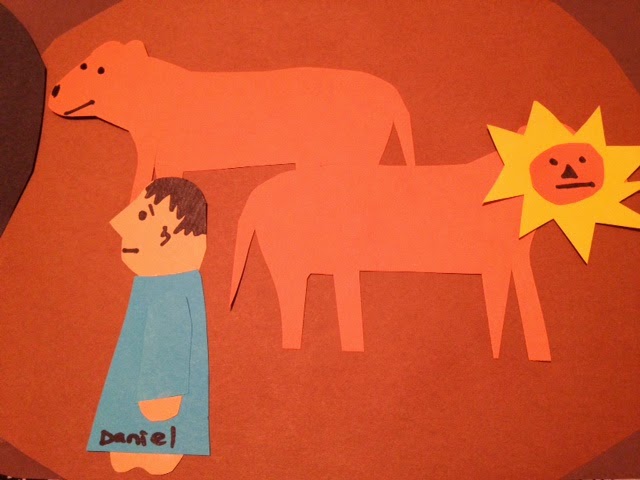
ACTIVITY:  Daniel In The Lion's Den
Materials needed: 12" x 18" dark brown construction paper, 9" x 12" light brown construction paper, 9" x 12" black construction paper, 8" x 12" medium brown construction paper, scraps of yellow, tan, blue paper, marker, fastener, glue, crayons, scissors.

  1. Hand out dark brown paper.
  2. Round edges with scissors, forming a rough oval. This is the den.
  3. Hand out light brown and black paper.
  4. Round edges of both papers at the same time.
  5. Set side black paper. This is the rock or stone that was in front of the mouth of the den.
  6. Glue the light brown paper towards the middle bottom of the dark brown paper. This is the inside of the lions' den.
  7. Draw two lions on the medium brown paper.
  8. Cut out lions.
  9. Glue lions inside of light brown paper.
  10. Out of scrap of yellow paper, cut a circle. This is the lion's mane.
  11. Cut small zigzags on yellow paper to resemble lion's mane.
  12. Glue yellow paper on one lion's face.
  13. Cut small circle out of medium brown. This is the lion's face that has the mane.
  14. Glue face on top of yellow circle.
  15. Draw Daniel's head, feet, and hand out of tan scrap of paper.
  16. Cut a triangle out of blue scrap. This is Daniel's clothes.
  17. Glue head on blue clothes.
  18. Cut a small rectangle out of the blue. This is Daniel's arm.
  19. Glue arm on clothes.
  20. Glue feet at the bottom of the blue triangle.
  21. Glue hand at the end of the blue arm.
  22. Color faces of lions and Daniel.
  23. Write "Daniel" at the bottom of Daniel's clothes.
  24. Line up black rock and light brown insides of the den.
  25. (Bible Teacher might need to help with this step). Poke hole through black paper, light brown and dark brown paper, so that when fastener is inserted, the rock moves to cover up and to show Daniel and the lions.
  26. Insert fastener.
  27. Closing the rock, draw a few white circles on top of rock's edge. These are the seals of the king's and the officer's rings.
  28. Write "Daniel In The Lions' Den" and "Daniel 6" on the dark brown den with white crayon.

Wednesday, November 5, 2014

Lesson - The Writing On The Wall


VERSES:   Daniel 5:1-31

MEMORY VERSE:   Daniel 5:25  "And this is the writing that was written, MENE, MENE, TEKEL, UPHARSIN."

BOOK TO REMEMBER:   Titus. Write "Titus" on slips of paper and hand out to the students at the end of class, so they will be taken home to memorize.

PRAYER:   Thank God for being a just God.

SPECIAL SONG:   Be Careful Little Eyes (see March - Songs We Sing In Bible Class #3 on this blog. Click orange circle for tune.)

VISUAL AID:   Draw a large Activity (see below) on whiteboard or chalkboard.

LESSON POINTS:
  • Belshazzar was the son of King Nebuchadnezzar, who was the king of Babylon. This name was very close to what the officer of Babylon had given Daniel as a new name when he first came to Babylon as a captive, but Daniel's name was Bel-te-shazzar. Close, but not the same.
  • Belshazzar made a huge feast and a thousand people came. They drank a lot of wine at Belshazzar's party, but before Belshazzar drank anything, he ordered someone to go and get the gold and silver vessels which his father, King Nebuchadnezzar had taken from Jerusalem. Do we remember where Nebuchadnezzar had taken the vessels from in Jerusalem? God's temple!
  • When they brought back the gold and silver vessels, the king, his wives, his princes--all the very important people--drank wine from the vessels that were from the temple of God that had been in Jerusalem! They should not have done that! They drank wine from the vessels and praised the idols of Babylon, their gods that were made from gold, silver, iron, brass, wood, and stone.
  • Within that same hour, the king looked up and saw the fingers of a man's hand writing on the wall of the palace close by where they had a candlestick. The king's conscience troubled him. He must have thought about drinking wine from the vessels that were from the LORD's temple. The Bible says that his thoughts troubled him so much so that his joints loosened up and his knees were shaking against each other! He was afraid! The king cried out loud and called for his astrologers and magicians who were called "wise men of Babylon" to tell him what the words meant that were written on the wall. None of Belshazzar's wise men could interpret the writing on the wall. But the queen remembered that Daniel could interpret dreams and suggested calling him in to help.
  • Daniel was brought before the king and the king wanted to make sure that Daniel was the same man who could interpret dreams. The king said that if Daniel could interpret the writing on the wall, he would give him new scarlet clothes, a gold chain for his neck, and he would be promoted to the third ruler in the kingdom.
  • When Daniel spoke, he said that the king could keep his gifts and give the rewards to someone else, yet he would still read the writing on the wall and tell the king what it meant. Daniel then reminded the king that the Most High God gave Belshazzar's father a kingdom and many rewards and honor. Daniel said that everyone feared King Nebuchadnezzar, but when his heart was full of pride, the LORD God brought him down to eat the grass of the earth until he had humbled himself. But, Daniel said, Belshazzar had not humbled himself even a little bit. His heart, too, was full of pride and, now, his servants had brought the king the vessels from the temple of the LORD, and he and the important people had drunk wine from them and praised their idols who could not see, hear, or know. King Belshazzar had not glorified and honored the LORD God at all, so the writing on the wall was sent to him by God. Then, Daniel told what the writing, MENE, MENE, TEKEL, UPHARSIN, meant.
  • MENE-meant that God had numbered his kingdom and it was finished.
  • TEKEL-meant Belshazzar had been weighed in the balance and had been found wanting.
  • PERES- meant the kingdom had been divided and given to the next kingdom, the Medes and the Persians.
  • Belshazzar then commanded that Daniel be given the scarlet clothes, the gold chain, and he became the third ruler in the land. But...that night, Belshazzar died and his kingdom was given to Darius, the Median, who took the kingdom, so now there was a new king, Darius, and a new nation who ruled over the servants of God who were taken from Jerusalem.
  • God's Word was true. God knows the future. God is in control. We always need to remember those very important things.
"Older Student" Tips:
  • Talk about how we can be taught by the Bible and our conscience can be taught good things. When we go against what we know is true, our conscience can trouble us like King Belshazzar's conscience troubled him. Read Romans 14:23. We need to make certain that they things we do are from faith, then we do not sin.
  • The Chaldeans were also called Babylonians.
  • The Medes and the Persians ruled at the same time.
  • We do not know why the interpretation is a bit different than what was written on the wall, but we do know the meaning.
ACTIVITY:
Materials needed:  9" x 12" purple construction paper, 6" x 8" light brown construction paper, 4" x 6" yellow construction paper, scrap of red foil, 8.5" x 11" white bond paper, glue, marker or black crayon.

  1. Hand out brown paper.
  2. Draw hand, writing (see picture). It's not hard.
  3. Cut out hand. Set aside.
  4. Hand out yellow paper.
  5. Draw candlestick (see picture). This is not hard, either.
  6. Cut out candlestick. Set aside.
  7. Hand out white paper.
  8. Write in large letters, "MENE, MENE, TEKEL, UPHARSIN" and "Daniel 5" on white paper.
  9. Hand out purple paper.
  10. Glue white paper on purple paper.
  11. Glue hand in corner of white paper.
  12. Glue candlestick beside hand.
  13. Hand out red foil.
  14. Cut out a flame.
  15. Glue flame on candlestick.
  16. Decorate candlestick.

Tuesday, November 4, 2014

LIST - Extra Helps


This page is designed with the intent of aiding those who are searching this blog for the Extra Helps articles. Hopefully, this will make your search easier, thus saving time for the busy Bible Teacher. Simply note the date of the entry, find the month on the Blog Archive Box and click! May we all be more curious, informed, and enlightened with this blogging aid.

New entries will be added as they are created. 

  1. February 2, 2014             Memory Verses, Bookmarks, and Letters
  2. June 21, 2014                  Pictures
  3. July 2, 2014                      Helping Hands
  4. July 3, 2014                      Teaching Materials Pantry
  5. July 30, 2014                    Teach The Bible!
  6. July 31, 2014                    Buying Or Making Materials?
  7. September 11, 2014       To Laminate Or Not To Laminate?
  8. September 23, 2014       Celebrating The Search Box
  9. October 10, 2014             "Books To Remember" Idea
  10. October 11, 2014             Giving Away Bibles
  11. October 22, 2014             Sometimes We Forget
  12. November 1, 2014           Worksheets Or Creative Projects?

Monday, November 3, 2014

LIST - Words of Encouragement Along The Way


Some say that when they go shopping, they take a list to help them remember. A dear sister in Christ used to cover the outside of her Bible with sticky notes to remind herself of things to do or things to say to people at Wednesday night Bible class. Myself? I make lists of places to go on a particular day, so I won't forget to do something. Perhaps, you do the same.

Tonight, I offer a list of a different kind--a list of encouraging words. After many months of blogging, there is much material accumulated and I believe it is difficult to find the Words Of Encouragement amid all the Lesson material on this blog, so presented on tonight's blog is a list of the Words of Encouragement articles found here on the blog. Simply find an article of interest, note the month it was written, then click on the month under "Blog Archive." 

Also, a special page has been created in hope that it will be easier to find all of these articles. Just look to your right of this article right now and you will find a special page entitled "SPECIAL  ARTICLES." Click on the article of choice.

Hopefully, you will find these writings beneficial, encouraging and read them when you need a gentle reminder to go back to the Bible for a Bible lesson, or for a simple thought to think about, or maybe for that encouraging pat on the back, as all Bible teachers need at one time or another. (This list will grow as articles are created. Keep checking!)

  1. March 2014                    Before The Lessons Begin
  2. March 2014                    Know It Well
  3. April 2014                       Answer, Yes!
  4. May 2014                       Serious Business
  5. June 2014                      Reaching Into The Home
  6. July 2014                        No Substitute For God's Word
  7. August 2014                   Are We That Someone?
  8. August 2014                   Are Numbers Important?
  9. August 2014                   Your Influence
  10. September 2014             You Can Feel Good About That!
  11. September 2014             Words Make A Difference!
  12. October 2014                  Background Thinking
  13. November 2014.             Quiet Study

Sunday, November 2, 2014

Lesson - The Fiery Furnace


VERSES:   Daniel 3:1-30

MEMORY VERSE:   Daniel 3:17   "...our God whom we serve is able to deliver from the burning fiery furnace..."

BOOK TO REMEMBER:   1 Timothy. Write "1 Timothy" on small slips of paper and hand out at the end of Bible class to take home to memorize.

PRAYER:   Thank God that we serve a God who can deliver us from evil.

SPECIAL SONG:   No, Not One (see June - Songs We Sing In Bible Class #6 on this blog. Click orange circle for tune.)

VISUAL AID:   TV Box (see February - Visual Aid #1 on this blog for instructions)

LESSON POINTS:

  • We remember that Daniel, Shadrach, Meshach, and Abednego were taken into Babylonian captivity and were living in the palace as servants. Ever since Daniel had interpreted the king of Babylon's dream, the four friends had been promoted to the important job of overseeing the affairs of Babylon.
  • King Nebuchadnezzar decided to create a HUGE golden image in the middle of the Plain of Dura in Babylon. The image was 90 feet tall and 9 feet wide and was made of pure gold. After the king had the image set up for all to see, he invited all of the important people--the judges, governors, captains, treasurers, counselors, sheriffs, and rulers--to the dedication of the image. When all the people arrived and were all standing in front of the image, the king had a herald, who was a person who shouted out the king's commands, announce that when all the people heard the music of many different instruments play, then the people were to bow down and worship the image. Whoever did NOT fall down and worship the image would be cast into a burning, fiery furnace.
  • Soon, the music played and Shadrach, Meshach, and Abednego did NOT fall down and worship the idol. Some of the Chaldeans, who had seen the three friends not fall down and worship the image,went straight to the king and told on the three men. The king was very angry and went into a rage. He commanded that Shadrach, Meshach, and Abednego be brought to him. He asked them if they served Babylon's gods and the golden image that he had set up. He asked them if they knew that if they did not worship the golden image then they would be thrown into the burning, fiery furnace. The three men answered the king, "We are not worried, King. Our God is able to deliver us from your fiery furnace and from your hand if necessary. But, if He chooses not to save us, then let it be known to you that we will not serve your gods nor worship the golden image which you set up."
  • The king was tremendously angry and full of fury! His face showed how angry he was at the three men. He commanded that the furnace be turned up SEVEN times greater than it had been! Then he commanded the strongest and mightiest soldiers in his army to bind Shadrach, Meshach, and Abednego and throw them into the burning, fiery furnace. Now, the three men still had their coats, hats, and other clothes on when they were thrown into the furnace. Because the king's command was urgent and the furnace had been turned up so much, every one of the soldiers who had bound and thrown Shadrach, Meshach, and Abednego into the furnace died. But Shadrach, Meshach, and Abenego fell into the burning, fiery furnace still bound up.
  • Then King Nebuchadnezzar was astonished and hurried in to see his governors and asked them, "Didn't we throw THREE men bound into the fiery furnace?" They answered the king, "Yes, that is true, O, king!" Then the king said, "I see FOUR men walking about in the middle of the fire. They are not even hurt! And the fourth man looks like the Son of God!" The king went to the mouth of the furnace and shouted, "Shadrach, Meshach, and Abednego, the servants of the Most High God! Come out of the middle of the fire!" And the three friends came out of the furnace unharmed. All the important people and the king saw that the fire had no effect on the men that had been inside the furnace. There was not a hair on their head singed, their coats had not been burnt even a little bit, and they did not even smell like smoke! 
  • King Neduchadnezzar was humbled and said, " Blessed be the God of Shadrach, Meshach, and Abednego, who sent his angel, and delivered his servants who had trusted in Him, have changed the king's words, and only served the LORD God. Therefore, I make a decree that if anyone speak anything against their God, they shall be cut into pieces and shall lose their home because there is no other God who can deliver like this!"
  • Then Shadrach, Meshach, and Abednego were all promoted again to a higher job in Babylon.
  • It is true what the king said. There is no other God like the LORD God. He is the only one who could save these three men in this way. This miracle showed that God was the true God and could do anything!

"Older Student" Tips:
  • The furnace must have had some way to see inside from the outside because the king said he saw four men walking about in the middle of the furnace.
  • Miracles like this one always proved that God was the One True God.
  • Shadrach, Meshach, and Abednego had complete faith in God to save them from this terrible situation. They believed that if the LORD would not save them, then it was His will. They believed in God with their whole heart just like we should.
  • When the king called the men from the mouth of the furnace and said that they were the servants of the Most High God, how did King Nebuchadnezzar know about the Most High God?  Daniel, who was in the palace and had impressed the king with his wisdom and interpreting of dreams must have mentioned the Most High God (Daniel 2:28).

ACTIVITY:   The Fiery Furnace
Materials needed:  6" x 12" black construction paper, 4" x 4" black construction paper, 6" x 12" red foil, glue, scissors, tape, white crayon.

  1. Hand out 6" x 12" black paper.
  2. Fold paper in half; fold in half again.
  3. Unfold paper.
  4. Draw a square in second panel of black paper.
  5. Cut out square.
  6. With white crayon, write "FURNACE" above the square.
  7. With white crayon, write "Daniel 3" below the window.
  8. Set black paper aside. This is the furnace.
  9. Hand out red foil.
  10. Fold foil in half; fold in half again.
  11. Cut jagged edges on edge of foil like grass.
  12. Unfold red foil.
  13. Glue red foil inside black furnace.
  14. Trim foil in window, so there is no foil in the window area. Set aside.
  15. Hand out 4" x 4" black paper.
  16. With white crayon, draw four men without faces, just the silhouette.
  17. Cut out four men.
  18. Glue men on the foil on the fourth panel. You should be able to see the men through the window.
  19. Fold outside edges of black edges, so they meet together in the middle.
  20. Secure with tape, so the black paper forms a box when it stands up on a table.